

What It Costs A Plumbing Business To Rank For Searches That Never Convert
What does it actually cost a plumbing business to rank first for a search that never converts into a booked job?
Most owners can name their monthly marketing spend without hesitation. Far fewer can say which of the results that spend produces are searches from someone with a leaking pipe and a working phone, versus someone scrolling for general plumbing information three states away.
That gap between visibility and revenue is where local search budgets disappear. Closing it does not require more spend. It requires knowing which surfaces produce calls, in what order to fix them, and how to prove the fix worked before paying for the next one.
Separate Profitable Local Visibility From Empty Traffic
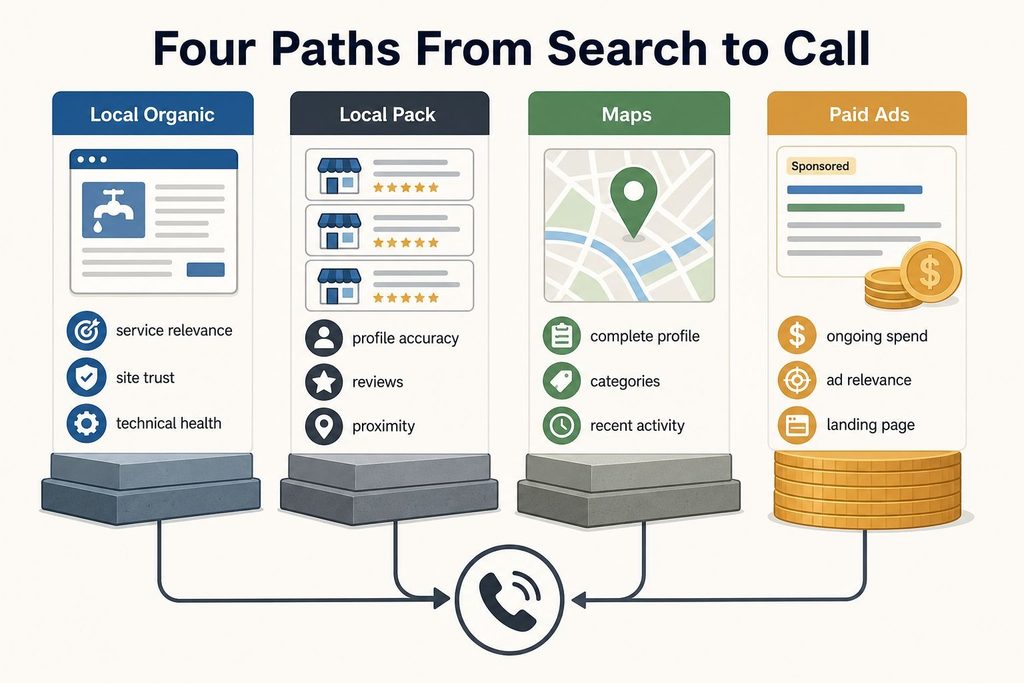
A plumbing business does not need to rank for every plumbing-related search that exists. It needs to appear, with credible proof, in front of people who are close enough and ready enough to book. That distinction changes what “success” looks like on a report, and it changes what gets funded next.
Four surfaces compete for that attention, and they are not interchangeable. Google’s local pack, the block of three business listings that typically appears above organic results for location-based searches, draws heavily on Google Business Profile information to decide who qualifies. Organic rankings, map visibility, and paid ads each work on a different mechanism and reward different proof.
| Surface | Where It Appears | What Proves Eligibility |
|---|---|---|
| Local organic results | Standard search results page, below ads and the local pack | Service page relevance, site trust signals, technical health |
| Local pack (3 listings) | Above organic results, tied to location intent | Google Business Profile accuracy, reviews, proximity |
| Google Maps visibility | Map search and navigation queries | Profile completeness, categories, recent activity |
| Paid ads | Top of results, marked as sponsored | Ongoing spend, ad relevance, landing page quality |
Local SEO is the only one of the four the business actually owns outright. Paid ads stop producing the moment spend stops. The local pack and map results can be earned and held without a recurring media bill, which is exactly why they deserve the first pass at the budget.
Choose Keywords That Earn Profitable Calls
The most common way plumbing marketing budgets get spent without return is chasing search terms that sound important but do not match how the business gets paid. A page built around “types of pipe materials” or “how plumbing works” might pull in visitors, but very few of them are holding a phone and a burst pipe at the same time. Volume without intent is a cost center dressed up as traffic.
A workable keyword framework ranks opportunities by proximity to revenue, not by search volume alone. Three tiers do the sorting:
- Emergency and high-margin services first. Same-day drain repair, water heater replacement, burst pipe response. These are searches made by someone who needs a plumber today and will pay accordingly.
- Location-qualified services second. Patterns like [service] + [city] or licensed plumber near me, where intent is clear but urgency is lower.
- Educational content last. The “repair” definitions and maintenance explainers are useful for trust and site depth, but they are not where the first dollar should go.
Evaluating any candidate keyword means weighing five things together rather than picking one:
- Search volume tells you if anyone is asking.
- Keyword difficulty tells you what it costs to compete for the answer.
- Local intent tells you if the asker is in a serviceable area.
- Conversion rate and cost per lead tell you what happens after they find you.
A high-volume, low-difficulty term with no local intent is not a win, it is a distraction with good vanity numbers.
Dispatch capacity has to sit inside this decision, not outside it. A two-truck operation ranking for every emergency term across a metro area will generate calls it cannot answer fast enough, which damages the review record that local rankings depend on. The keyword list should be built against a real service radius, and it should deliberately exclude the jobs the business does not want. Chasing volume on low-margin repairs the crew dislikes doing is a bad trade even when the ranking is achievable.
Businesses working through this prioritization from scratch often need a structured framework rather than an intuitive list, which is where a dedicated guide to seo for plumbers is useful as supplementary reading rather than as the plan itself.
Build Google Business Profile Proof Before Publishing More Pages
Before a single new page gets written, the Google Business Profile deserves a full audit. It is the one asset that feeds both the local pack and Google Maps directly, and inaccuracies there cost visibility for reasons that have nothing to do with content quality. Fixing it is fast, free, and produces measurable movement faster than most other local SEO work, which makes it the correct place to spend attention before spending money.
The profile actions below can each be completed independently, in any order, without waiting on the others:
- Verify categories and core services match what the business actually performs and are not padded with services rarely offered.
- Set accurate service areas and availability, including whether the business genuinely runs 24-hour emergency dispatch or only during business hours.
- Add original job photography and credentials, replacing stock imagery with documented completed work.
- Maintain review management by responding to reviews factually, without disputing details in public or making claims that cannot be verified.
Match Operational Facts
Google Search and Google Maps reward profiles where the stated facts match reality: the hours are the actual hours, the service area is the actual coverage zone, and the categories reflect actual capability. A profile claiming 24-hour emergency service that goes unanswered after 6pm creates a mismatch that shows up in call abandonment and, eventually, in review language.
Show Local Proof
Photography of completed jobs, visible license numbers where locally required, and specific technician credentials all function as evidence a searcher can check quickly. Any claim involving licensing, insurance coverage, or certifications should be reviewed against the applicable local code before it appears anywhere public.
This is not a place to guess.
What Belongs On A Service Area Page
A service area page earns its place only if the business can actually dispatch there reliably. The temptation to generate a page for every neighboring town, regardless of whether trucks regularly go there, produces thin content that neither converts well nor holds rank, because it is not backed by real operational depth.
A single reusable template, applied to one service in one genuinely served area, does the job better than dozens of near-duplicate pages.
- It should state the specific problem being solved and whether same-day availability exists in that area.
- It should name any local operating detail worth mentioning, such as typical response windows.
- It should include some form of proof, such as a completed job or a credential, and it should offer one clear path to book or call.
- That structure connects directly to local intent: a page that answers the actual question a nearby searcher has converts at a different rate than a page that merely mentions a city name for keyword coverage.
Structured data, applied correctly, describes the business and its services to search engines in a machine-readable format. It should be validated for accuracy against what the page actually says, not treated as a way to influence ranking directly. It is also not a substitute for the Google Business Profile: the profile governs map and local pack visibility, while service area pages govern how the business shows up and converts inside organic search.
Repair On-Page Signals And Local Trust Gaps
A competitor sitting above the business in local results is frequently not outspending it. More often, the competitor’s pages simply present clearer proof and are easier to book from, which is a fixable condition rather than a budget problem. Before assuming more money is the answer, an honest audit of existing signals usually finds cheaper fixes first.
The items worth checking, in one pass, are:
- Service-page titles and explanations that match the intent behind the keyword they target, not generic descriptions.
- Accurate name-address-phone details, consistent across the website and every listing.
- Citation building consistency, meaning directory and platform listings that match the profile exactly.
- Review management that is active rather than dormant.
- Technician credentials stated where locally appropriate.
- Original photography rather than stock imagery.
- A mobile booking path that works without friction.
Align Page Evidence
Titles and descriptions should reflect what the searcher is actually trying to accomplish, whether that is an emergency fix or a scheduled installation, rather than reciting service categories in generic language.
Reconcile Local Listings
Name, address, and phone details that differ even slightly across citations create confusion that search engines and customers both notice. Google Search Central notes that responsive design, serving the same HTML on the same URL across devices, is the simplest way to keep mobile and desktop experiences aligned.
It also warns that conflicting noindex or nofollow directives between mobile and desktop versions of a page can block crawling or indexing entirely. That is a technical failure that looks identical to a content problem from the outside, which is exactly what makes it worth checking early rather than assuming the content is at fault.
Earn Authority Through Relevant Local Evidence
Off-page signals matter, but only when they are real. A supplier relationship, a trade association membership, a sponsored community event, or a genuine project reference from a builder all carry weight because they can be checked and they say something true about the business’s standing in the area it serves.
Bought links and irrelevant directory placements do the opposite: they consume budget while adding nothing a searcher or a search engine can verify. Every external mention should agree with what the citation records and the website already say about service areas and services offered.
Consistency, not volume, is what makes this category worth the spend. What works for a local competitor elsewhere cannot be assumed to transfer here, since behavior in other markets is not a reliable guide to this one.
Measure Calls Before Expanding The SEO Budget
Rankings alone tell a budget holder very little. A page or profile ranking well but producing few qualified calls is not a success, whatever position it holds.
The scorecard worth checking on a regular basis is short:
- Rankings by service area and service, pulled from a rank tracking tool, show where visibility exists.
- Qualified calls and booked estimates, cross-referenced against Google Analytics and call records, show whether that visibility converts.
- Revenue by service and conversion rate show whether the converting calls are worth having.
- Cost per lead, weighed against all of the above, is the number that decides whether spend should continue, change direction, or stop.
Google Search Console adds the missing layer: which queries are actually driving impressions and clicks to which pages, which is often different from what was assumed during keyword selection. A page or profile effort that fails this scorecard should be revised or retired before another page gets commissioned.
Expansion without this check is how budgets drift toward pages that look productive and are not.
Start With Five Services In The Next Forty-Eight Hours
Fixing everything at once is how local SEO budgets get spent without a clear return. A narrower first move produces a baseline that later spend can actually be judged against. The sequence matters more than the individual tasks, because each step depends on information the previous one produced.
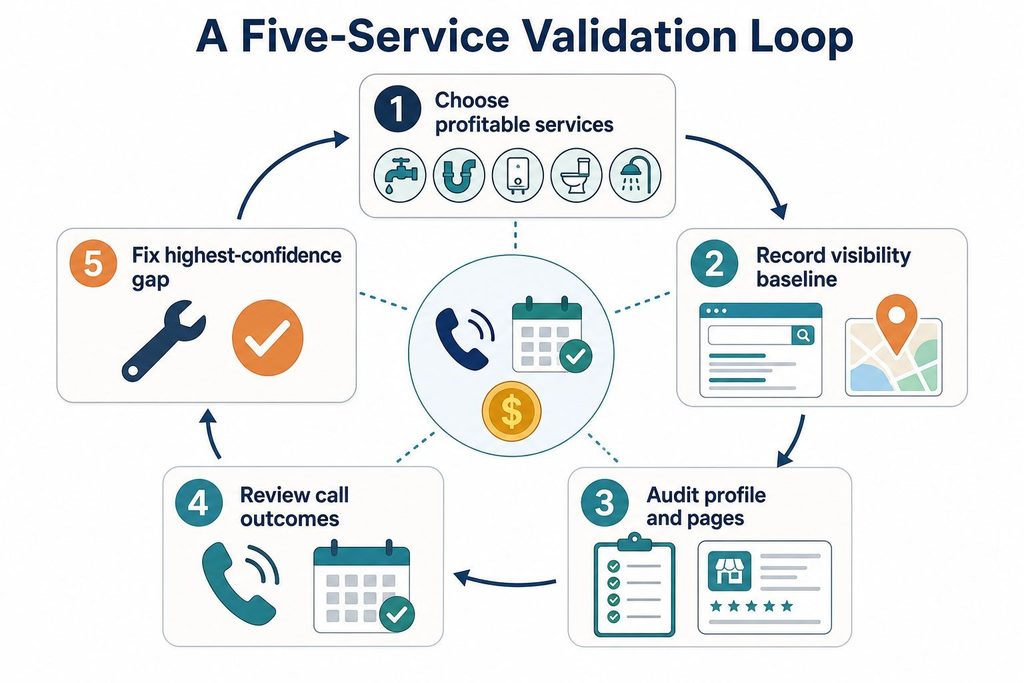
- Name the five services that most reliably produce profitable, booked work. This has to happen before anything else, because auditing signals before knowing which services matter wastes the audit.
- Record exactly how each of those five services currently appears across the local pack, maps, and organic search. This baseline is what later spend gets judged against.
- Check the Google Business Profile facts for those five services specifically, along with the corresponding service pages and the proof attached to each.
- Pull recent call outcomes for the same five services to see where the mismatch between ranking and revenue actually sits.
- Close the single gap with the highest confidence of mattering, whether that is a missing category, an outdated service area, or a page with no real proof on it.
That fix, and the baseline behind it, is what turns the next round of spend into a decision rather than a guess.