

A Regional Plumbing Operator’s Warning About Lead Volume
A regional plumbing operator once signed with an agency promising three hundred leads a month, and got them. Call volume tripled inside six weeks. Booked jobs did not move, because most of the calls were price shoppers asking about a flat-rate drain snake, calling five other companies in the same hour, in a service area with no capacity for same-day repiping consults.
The lead count looked like a win in the recap deck. The bank account told a different story.
That mismatch is common precisely because lead volume is easy to sell and easy to measure, while job value and service-line fit are neither. A proposal built around raw lead counts hides the difference between a five-minute drain call and a repiping project worth ten times as much,
and it hides that difference on purpose, because the alternative requires the provider to be accountable for outcomes instead of activity. Fixing that starts with what gets asked before a contract is signed, not after the first invoice arrives.
What Evidence Should a Plumber Marketing Service Provide Before It Is Hired?
The buying mistake almost always starts the same way: a proposal quotes a lead volume or a cost-per-lead figure with no definition of what counts as a lead, no separation by service line, and no proof that the provider has produced booked jobs for a plumbing business before. Signing on volume alone is how an operator ends up with hundreds of low-value enquiries and no additional repiping revenue to show for the spend.
What Actually Needs Comparing
Six dimensions separate a credible proposal from a decorated one: strategic fit with the business’s actual job mix, channel execution detail, measurement infrastructure, conversion handling, commercial terms, and provider proof. A proposal that addresses only channels, the part that is easiest to make look sophisticated, has skipped the other five.
What Verification Actually Looks Like
Verification means a document, a login, or a call recording, not a claim in a sales deck. A provider who cannot produce a client-facing dashboard, a sample contract, or a reference the evaluator can call directly has nothing to verify, which is itself the finding.
| Provider Signal | Proof Required | Consequence If Missing |
|---|---|---|
| Plumbing industry specialization | Case studies naming service lines and markets served | Generic campaigns built for a different trade entirely |
| Track record with booked jobs | Client testimonials referencing job types, not just call counts | Volume metrics with no revenue connection |
| Certification claims | Copy of the credential or platform partner status | Unverifiable claims used as a trust shortcut |
| Reporting transparency | Live dashboard access, not a monthly PDF summary | No way to audit spend between report cycles |
| Commercial structure | Written scope tied to deliverables and access | Renegotiation position sits entirely with the provider |
Any evaluator comparing plumber marketing services should treat this table as the floor for a shortlist conversation, not the ceiling. A provider that clears all five rows still has to prove it understands the two service lines that actually carry margin.
Which Marketing Objectives Protect High-Margin Drain Cleaning and Repiping Work?
A brief that asks for “more plumbing leads” cannot be executed well, because it gives the provider no way to prioritize spend. A workable brief names the service area down to the zip codes that matter, the job types being promoted, a booking target stated as jobs rather than calls, and the economic priority, meaning which service lines carry the margin worth protecting first.
Drain cleaning and repiping behave nothing alike as buying decisions, and pooling them into one undifferentiated “plumbing services” campaign erases the difference that matters most. Drain cleaning searches are urgent, price-sensitive, and often decided within the hour. Repiping searches are considered, higher-ticket, and researched over days or weeks by a homeowner comparing quotes.
Each needs its own campaign, its own landing path, its own call-handling script, and its own line in the reporting, not a shared “leads generated” total that hides which service actually produced the booking.
A 2026 plumbing advertising guide from mcc.codes makes a similar case for keeping these campaigns apart, noting that drain-cleaning terms such as “drain cleaning near me” and “$99 drain cleaning” carry high purchase intent with estimated cost-per-click in the range of $8 to $18.
That figure is useful as a planning benchmark and nothing more. It was not measured in every regional market, and a provider quoting a fixed cost-per-click below that range without explanation deserves a follow-up question, not automatic trust.
Two further checks separate a serious brief from a hopeful one. First, service-area targeting has to be built around where repiping capacity actually exists, since a repiping crew that can only reach three neighborhoods gains nothing from ad spend blanketing the whole metro. Second, the provider has to show, in writing, how budget allocation and ad promotion choices favor the higher-margin service when both campaigns compete for the same daily spend cap.
A provider unable to answer either question in a proposal meeting is not ready to run the account.
How Should Local Search Coverage Be Checked Across the Real Service Area?
Local visibility gets misjudged more often than any other channel, mostly because “we rank well” is a claim almost nobody bothers to verify by zip code. Google Business Profile and local SEO guidance for plumbing businesses points to a specific, checkable set of profile elements, and each one is either present or it is not.
The check runs against six items:
- The Google Business Profile uses the primary category “Plumber,” not a generic contractor category that dilutes relevance.
- Service areas listed match the zip codes the business actually covers, not an inflated regional footprint.
- Business hours, including emergency availability where offered, are current and match the phone script.
- Contact details, including the tracked phone number, are accurate across every listing.
- Service descriptions explicitly cover drain cleaning and repiping, rather than a single paragraph of general plumbing copy.
- Photo uploads show real completed jobs, updated on a visible cadence rather than stock imagery uploaded once at setup.
Reporting has to reflect this same granularity: rankings and review visibility broken out by service area, not a single “we’re ranking well locally” statement with no zip-code detail behind it. A provider that can only speak in aggregates has not actually looked.
How Should Paid Campaigns Separate Urgent Drains From Planned Repiping Projects?
Paid media proposals need to show separation:
- by intent
- service line
- geography
- landing page
- call outcome
- across Google Ads
- general PPC
- and Google Local Services Ads
because a blended report across all three obscures which spend produced which booking.
| drain cleaning | repiping |
|---|---|
| A single “Google Ads performance” line item covering both | is a report designed to avoid a hard question, not answer one. |
The reasoning behind the separation is structural, not stylistic. An urgent drain cleaning search converts on speed: fast page load, a click-to-call button above the fold, and a phone answered on the second ring. A repiping search converts on trust: financing information, before-and-after photos, and a call handled by someone who can talk through scope before booking an estimate.
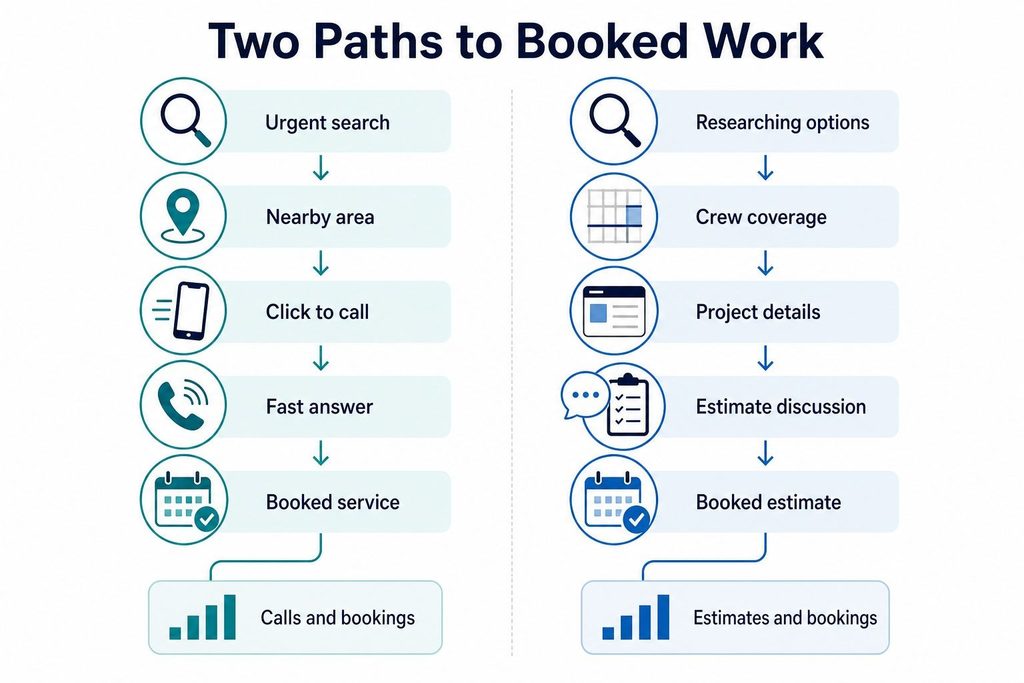
Running both through the same ad group, the same landing page, and the same intake script produces mediocre results for both.
What a defensible proposal quotes, by channel and by service line, is cost per lead, a written definition of what counts as a qualified lead, lead conversion rate, and job booking rate. What no defensible proposal quotes is a fixed number of calls or a promised booking count, since neither can be guaranteed against a market the provider does not control.
What Must Happen After a Plumbing Lead Reaches the Website or Phone Line?
Every dollar spent on visibility is wasted the moment a call goes unanswered or a form submission sits unread in an inbox. Conversion infrastructure is where marketing spend either turns into a booked job or evaporates, and it is the single most under-audited part of most proposals.
Seven questions should be answerable with a screen, a call log, or a workflow export, not a verbal assurance:
- Mobile readiness: does the drain cleaning and repiping page load and function correctly on a phone, without a desktop-only layout forcing a pinch and zoom?
- Calls to action: is the next step for each service line explicit, distinct, and visible without scrolling?
- Call tracking: does every tracked number route to a recorded line the operator can review?
- Form attribution: can a form submission be traced back to the specific campaign and keyword that produced it?
- CRM lead status: does every lead record show a current status, rather than sitting untouched after intake?
- Booking ownership: is one named role, internal or agency-side, responsible for converting a qualified lead into a scheduled job?
- Follow-up automation: does an unanswered lead get a second contact attempt within a defined window?
None of this exists to police the front desk. It exists to stop a paid or local-search lead from being logged as a marketing success before anyone has confirmed a job was actually booked.
Which Reports Show Whether Marketing Is Producing Profitable Plumbing Jobs?
Reporting failures tend to look identical across otherwise different agencies: a raw lead count with no job-status field attached, drain cleaning and repiping data blended into one “plumbing” total, call recordings that are unavailable on request, and a dashboard that stops at the click and never shows what happened after.
A complete report carries seven fields: cost per lead, return on investment, lead conversion rate, job booking rate, customer lifetime value, search rankings, and customer reviews. Each of those numbers should be checkable against a source, not delivered as a rounded summary in a slide.
If drain cleaning and repiping are both being promoted, their results have to be visible as separate lines. A single “plumbing services” figure that combines them is not a report, it is an average with the information removed.
Distinguishing a reported metric from an agency’s interpretation of that metric matters here. “Cost per lead was $34 in the drain cleaning campaign” is a fact. “The campaign is performing well” is a conclusion, and it should never be accepted as a substitute for the number behind it.
Which Contract and Pricing Details Make a Marketing Proposal Comparable?
Two proposals quoting different monthly fees are not comparable until the packages behind those fees are normalized against the same categories. Scope by channel is the first check: does the fee include Google Ads management, Local Services Ads, SEO, or some combination, and is ad spend included in the quoted number or billed separately.
Ownership is the second check: who holds the ad accounts, the website, and the creative assets if the relationship ends, because a provider that retains ownership of everything built during the engagement has effectively locked in the client regardless of performance.
Five further items decide whether a lower monthly fee is actually a better deal or just a smaller scope dressed up as a bargain:
- Reporting cadence, and whether it matches the pace of spend rather than a fixed monthly calendar.
- Contract term length, and what penalty, if any, attaches to leaving early.
- Cancellation conditions, spelled out rather than left to a renewal clause.
- The provider’s written definition of a lead, not a verbal description offered in the pitch.
- Who is responsible for changes to the website or CRM when campaigns require them.
A provider unwilling to put a lead definition in writing is protecting itself, not the client’s spend. Price has to be pinned to deliverables and to measurement access, since a proposal that implies the cheapest monthly fee is automatically the best value is asking to be judged on the one number it controls and none of the ones that matter.
Which Provider Signals Justify a Final Plumbing Marketing Decision?
Any name that surfaces in search results during this process, including Plumber Marketing USA, should be evaluated against this same documentation standard rather than accepted or dismissed on reputation alone, since no independent evidence here confirms performance claims for that or any other specific provider.
Walking away is the correct call when a provider shows one or more of these observable signals:
- No plumbing-specific case studies on file, only general home-services examples.
- No client testimonials that reference actual job types, only call counts or star ratings.
- A certification claim with no credential or partner listing to back it.
- No multi-year track record with a plumbing business, regional or national.
- No reputation evidence beyond the provider’s own marketing site.
- No distinct strategy for high-margin service lines like repiping, separate from general plumbing.
- No transparent access to underlying performance data, only a summary report on request.
The single action worth taking today is sending this same evidence checklist to every shortlisted provider and comparing nothing except the documentation that comes back. The proposal that arrives with fewer promises and more proof is the one worth a second meeting.