

Answering The Nearby Emergency Call When Homeowners Need Help Fast
A plumbing company doubles its Google Business Profile posting, adds a second service area, and buys a run of local ads, then finds the phone quieter than it was three months earlier. The audit that follows usually turns up the same problem: the profile lists emergency hours that dispatch cannot actually cover, a service area that includes towns the company has never sent a truck to, and a phone number on the website that routes to a voicemail box nobody checks after 6pm.
None of that shows up in a rankings screenshot. All of it shows up in lost jobs. This is common because visibility work and dispatch capability are managed by different people, on different schedules, answering to different pressures. Marketing wants the profile to look complete. Operations wants the truck count to match reality. When those two accounts of the business disagree, the customer finds out first, usually at the worst possible hour.
Measure The Cost Of Invisible Emergency Calls
Local search exists to connect a homeowner with a burst pipe to a business that can reach them quickly. The local pack, the map-based results block that appears for searches with local intent, is not a vanity placement.
It is the mechanism by which a search for a nearby emergency plumber turns into a phone call within minutes.
That mechanism only pays off if the profile behind it is accurate: correct hours, real emergency availability, a phone line that is actually staffed.
The gap that costs money is the one between a map impression and a booked job. A homeowner who taps a listing at 11pm and reaches a disconnected line, or is told the company does not serve their postal code despite the listing claiming otherwise, does not leave a complaint. They call the next result down.
That lost job never appears in a marketing report because nothing was tracked at the point of failure, only at the point of impression.
The commercial risk is not that local search fails to generate interest. In most cases it generates plenty.
The risk is spending against reach while treating the underlying business information as settled, when it has never been checked against what dispatch can actually deliver on a Tuesday night in the rain.
Eliminate Conflicting Local Business Signals
Inconsistent business information is the most common, and most fixable, source of wasted local visibility spend. Every citation, directory listing, and profile field is a small promise to a search engine and to a homeowner. When those promises disagree with each other, trust erodes on both sides at once.
A verifiable pass across the company’s local presence should confirm the following, in order of how much damage a mismatch does:
- Business name is identical, character for character, across the Google Business Profile, the website footer, and every citation source, with no added keywords or service descriptors folded into the name field.
- Phone number listed publicly matches the number actually staffed for emergency dispatch, not a tracking number that has since been retired or a landline nobody answers after hours.
- Hours of operation, including any listed 24/7 or emergency availability, match a real, current on-call rotation rather than a default template setting.
- Service area claims match the postal codes, cities, or regions the company can genuinely dispatch to, with no city added because a competitor lists it.
Guidance built specifically around plumbing company local seo treats this consistency check as foundational rather than optional, precisely because search engines and directory aggregators cross-reference these fields and penalize the ones that disagree.
An invented address or an unsupported service area does not just risk a technical citation flag. It puts a technician in a truck heading toward a customer the company was never equipped to serve, or worse, it puts the customer on hold waiting for a callback that was never coming.
Apply The 80/20 Test To Local SEO
Before spending shifts toward broader advertising, the sharper question is which small set of controllable actions is actually driving dependable local demand right now. The 80/20 rule, applied here, is a way of ranking effort, not a promise about outcomes. It asks which handful of checks, if wrong, would undercut everything else spent on visibility.
Four checks earn priority under that lens: whether the Google Business Profile information is accurate, whether service pages describe real, dispatchable work, whether reviews are being requested and answered on a schedule, and whether calls generated through local search are actually being counted. Each is answered by evidence sitting inside the business already, not by new spend.
Complete The Google Business Profile Before Buying More Reach
A Google Business Profile is not a listing to be filled in once and left. It is the primary interface between a search result and a decision to call, and its accuracy compounds.
A profile that is fully and correctly completed is reported to make a business appear roughly 2.7 times more likely to be seen as reputable, and 70% more likely to draw an in-person visit, according to a 2026 local SEO benchmark report. Those are trust signals a homeowner reads in seconds, before ever reaching the website.
The checklist that matters most, in consequence order, before any additional local visibility spend:
- Primary category and business name reflect the actual trade, with no unrelated services added to appear broader.
- Named services list the specific work performed (drain clearing, water heater repair, emergency leak response) rather than a generic “plumbing services” entry.
- Operating hours and any emergency or after-hours availability match the real on-call schedule, verified against the dispatch log rather than assumed.
- The primary phone number connects to whoever actually answers emergency calls, tested at an off-peak hour to confirm it rings through.
- Photos, business description, and attributes are accurate representations of the business, not stock imagery implying capability that does not exist.
Verify Dispatch Details
The phone number field deserves a second look on its own, separate from the general accuracy pass. A tracking number that reroutes correctly during business hours can fail silently after a call center closes, sending an emergency caller to a dead end at exactly the moment urgency is highest. Confirming this requires an actual test call outside standard hours, not a glance at the field in the dashboard.
Define Supported Service Areas
For a service-area business, the profile does not use a radius around an office address. It uses a list of designated cities, postal codes, or similar defined areas, up to 20 areas in total, and each one should represent a location the business can genuinely dispatch a technician to within its stated response window. Adding a distant suburb because it appears in a competitor’s listing, without the capacity to serve it, creates exactly the kind of promise that a late-night caller discovers is false.
Build Service Pages That Match Real Dispatch Coverage
Once the profile is accurate, the service pages it links to carry the next layer of proof. A homeowner searching for an emergency plumber rarely stops at the map result. They click through, and the page they land on either confirms the urgency was worth acting on or introduces doubt at the exact moment a decision was about to be made.
Match Services To Search Intent
A page built for emergency plumbing needs to state, in plain terms, what the emergency service actually covers:
| burst pipes | overflowing fixtures |
|---|---|
| no-heat situations in winter | sewage backups |
| whatever the business genuinely handles under an emergency call-out |
A page that buries this under a general “plumbing services” description, written once and applied to every location, gives a searcher no reason to believe the company understands the specific problem they are facing right now.
Prove Coverage Without Inventing Locations
Location pages built purely to rank for nearby suburbs, with no distinct content and no real service history there, are the thin, duplicated content pattern that damages trust twice over: once with search engines that recognize the pattern, and once with any customer who calls expecting local familiarity and gets a technician unfamiliar with the area. Every coverage claim on a page should be checkable against where the company has actually worked, not aspirational.
Beyond the service description and honest coverage statement, three more elements decide whether a page converts a caller:
- Matching contact details. The phone number and address on the page agree with the Google Business Profile exactly, with no legacy number left over from an old campaign.
- A conversion path built for urgency. A tappable number near the top of the page, not a contact form buried below a long scroll a stressed caller will not finish.
- Claims that describe capability, not adjectives. Language that states what the business actually does, rather than a superlative like “fastest” or “best” with nothing behind it.
A page that gets these elements right does not need to be clever. It needs to be accurate and easy to act on under pressure.
Create A Review Workflow That Builds Local Trust
Reviews function as both a ranking input and a trust signal read directly by the person deciding whether to call. Review signals, one 2026 industry analysis reports, account for 16% of local pack ranking weight, with recency and response engagement mattering more than the raw lifetime count. That shifts the operational question away from “how many reviews do we have” and toward “are we generating and answering reviews on a schedule.”
A workflow that can be checked as done or not done looks like this:
- Timing: the request goes out at the natural completion point of a job, when the work is fresh and the outcome is visible, not weeks later in a batch email.
- Framing: the request asks honestly for feedback about the experience, with no incentive offered and no suggested wording supplied to the customer.
- Monitoring: new reviews are checked on a set schedule, not discovered by accident.
- Response: every review, positive or critical, gets a documented reply within a defined window, showing an active business rather than an abandoned profile.
Guidance on plumber-specific local SEO from a marketing agency describes the Map Pack as often requiring a review base in the 40 to 80 range above 4.5 stars. Month-over-month velocity matters more for holding position than a large historical total, sometimes cited around 20 to 25 new reviews monthly.
A separate local SEO guide frames that velocity target the same way: treat the most recent 90 days as the period that counts, not the lifetime average. Neither figure is a guarantee. Both point to the same operational fact: review count without recent activity is a weaker signal than a smaller, consistently refreshed one.
Track Qualified Calls From Local Search
None of the profile, page, or review work is verifiable without a way to trace a call back to its source. The measurement chain runs from a Google Business Profile view or a service-page visit, through a call or form submission, to a booked job and eventually a completed invoice.
Each link in that chain can be measured; skipping a link is what turns a ranking report into a document that describes visibility without proving demand.
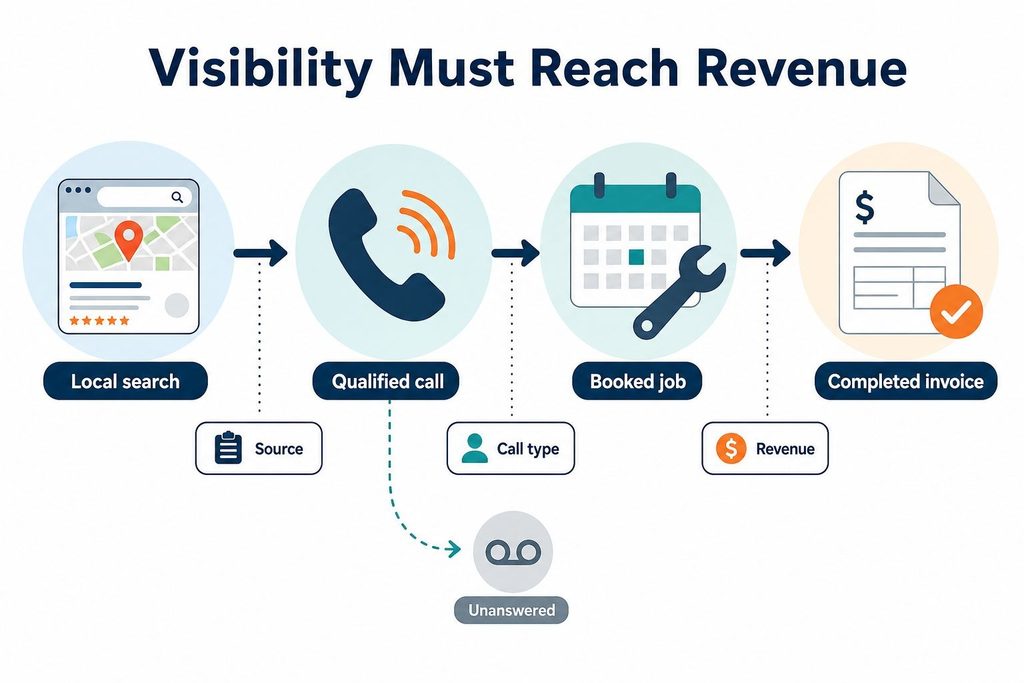
A dependable version of that chain needs four things in place at once. The table below separates what each piece measures from what happens when it is missing.
| Tracking element | What it measures | If it is missing |
|---|---|---|
| Source-level call tracking | Whether a call came from the Google Business Profile, the website, or organic search | Marketing cannot tell which channel is actually producing calls |
| Emergency versus routine tagging | Whether a logged call was a real dispatch or a general inquiry | Urgent calls get lost in a generic total that overstates demand |
| Referring-page tagging on forms | Which page a form submission actually came from | A converting page looks identical to a page nobody reads |
| Regular cost-to-call comparison | Qualified calls weighed against what was spent generating them | A popular listing gets mistaken for a profitable one |
Without that comparison, a business cannot tell the difference between a listing that is popular and one that is profitable.
A rankings screenshot showing improved local pack position is evidence of visibility. It is not evidence that the visibility produced a call, and it is certainly not evidence that the call turned into booked, paid work. Only the tracked chain, from impression through revenue, answers that question.
The local pack appears in 93% of local searches for local intent according to one 2026 SERP benchmark, which is precisely why the businesses that measure past the impression are the ones that know whether that dominant placement is earning its cost.
Run The First Forty-Eight Hours In Order
The sequence that follows protects against acting on the wrong problem first.
- Compare public claims against dispatch reality. Pull up the Google Business Profile, the website’s emergency page, and the current on-call schedule side by side. Check hours, phone routing, and every listed service area against what dispatch can actually cover today. This comes first because every later fix depends on knowing where the claims and the capacity currently disagree.
- Correct the highest-risk mismatch first. If the emergency phone number does not reliably connect after hours, fix that before touching service area lists or page copy. A caller who cannot reach anyone loses the job regardless of what the profile says, so this step outranks every other correction on the list.
- Record a call and form baseline. Before making further changes, log the current volume and source of calls and form submissions. Without this starting point, no later change can be shown to have helped or hurt, which makes this the step that turns the rest of the work into something measurable rather than assumed.
The order matters because each step depends on the one before it: there is no point correcting a service area list before confirming the phone actually rings through, and no point measuring improvement without first knowing where the numbers stood. The one thing worth doing today, before any of the rest, is placing that test call to the emergency line at an off-peak hour and listening to what a real customer would hear.