The Automated System for Generating 5-Star Feedback and Dominating Local Search
How many of the last twenty jobs a plumbing business closed generated a Google review without anyone in the office remembering to ask?
Most owners cannot answer that question with a number. They can guess. The guess is usually optimistic, and it is usually wrong, because the review a technician mentions in passing on a Friday afternoon rarely survives the drive to the next call.
That gap between finished work and recorded proof of finished work is where local search rankings get decided, without anyone noticing until a competitor’s profile shows forty reviews to a company’s twelve.
Audit the Review Gap in Local Search
A steady flow of authentic customer reviews does two jobs at once. It signals to Google’s local ranking system that a business is active and trusted. It also gives a homeowner comparing three plumbers in a five-mile radius a reason to pick one over the other two.
Neither effect happens from star count alone. A helpful plumber review names the actual problem (a slab leak, a failed sump pump, a water heater that would not relight), states roughly how fast the technician arrived, and says whether the price matched the estimate. That level of detail is what a prospective customer is actually scanning for.
The cost of skipping this is not a missing five-star badge. It is a slow bleed:
- Technicians who forget to mention it once the invoice is signed and the truck is already backing out of the driveway.
- Office staff juggling three review platforms with no clear owner assigned to any of them.
- A Google Business Profile that has not been checked in months, quietly falling behind competitors who update theirs weekly.
None of that shows up on a Tuesday. It shows up eighteen months later, in a rankings position that never moves.
Prepare Google Business Profile for Easy Feedback
Before any request goes out, the destination has to be ready to receive it. A profile with an outdated address, a wrong phone number, or a form-only path buried three clicks deep will lose a share of every request sent, regardless of how well the request is written.
A one-time setup pass should confirm:
- Business name, address, and phone number match exactly what is printed on invoices and trucks, since mismatches confuse both customers and Google’s matching algorithm.
- The direct review link is pulled from the Business Profile dashboard and shortened or saved somewhere the office system can reach it without a manual search each time.
- Secondary platforms (Facebook, an industry-specific directory, whatever the business already relies on) are chosen deliberately, not left at three or four scattered defaults nobody checks.
- The link is dropped into whatever system triggers the request, whether that is a CRM, a field service app, or a shared document the office team pulls from.
None of this guarantees a better rating or a faster climb up the map pack. It removes friction, which is the difference between a customer who taps twice and a customer who gives up on the third screen.
Trigger Requests When Jobs End Well
A verbal ask at the door does not scale, and it does not survive a busy week. The technician who remembers to ask on Monday forgets by Thursday, not from carelessness but because asking for a review was never actually part of the job, just something bolted onto the end of it. A system needs a trigger that fires the same way every time, independent of who is standing on the porch.
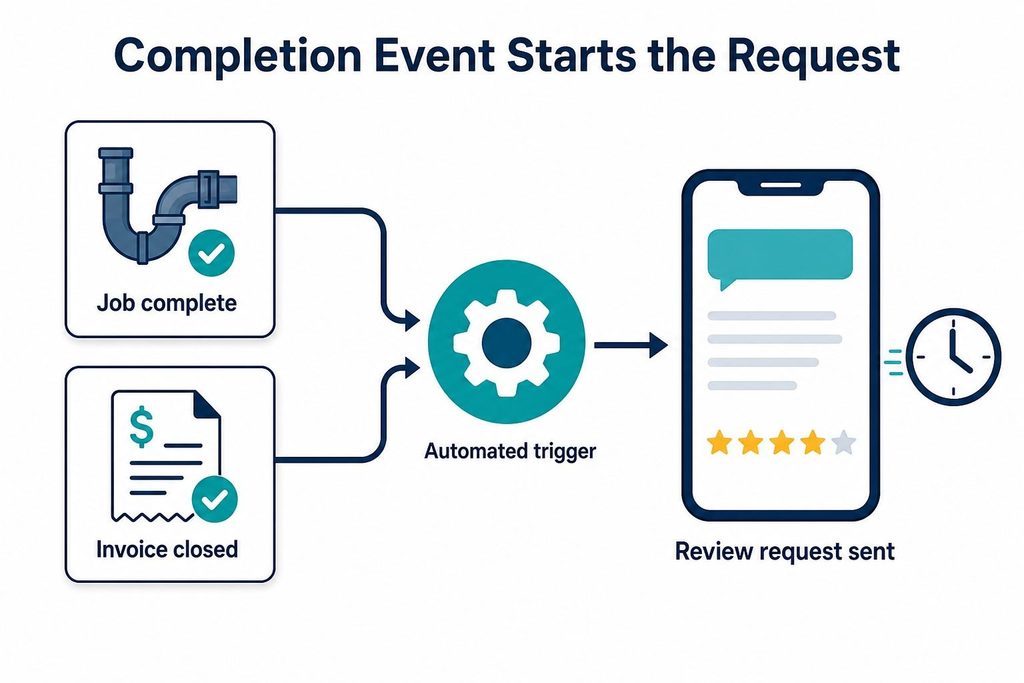
The trigger should be the event that is already recorded somewhere: the job status changes to complete, or the invoice closes out in the software the business already uses. That event, not a technician’s memory, starts the sequence.
Pick the Right Completion Trigger
Job-completion and invoice-close are the two events worth automating against, and one 2026 automation workflow built for plumbing companies recommends firing the request within minutes of whichever one happens first, while the customer is still standing in a clean garage or a dry basement. Waiting until end of day loses that immediacy. Waiting until the next billing cycle loses it entirely.
Write the Request Itself
The message that goes out should do three things and nothing more: thank the customer by name, name the work performed in plain language, and drop the direct review link with no extra steps between the text and the form. An SMS-led approach tends to outperform email here, mainly because a text gets opened within minutes while an email sits in a queue behind newsletters and receipts.
Keep the tone neutral. A request that reads as a plea, or that leans on urgency, tends to suppress responses rather than lift them, particularly from customers who already had a straightforward, unremarkable experience, which is most of them.
Schedule Follow-Ups Without Review Gating
One reminder is enough. Industry workflow data on plumbing review automation points to a single follow-up sent three to five days after the initial request for anyone who has not responded, and stopping there. A second or third nudge starts to read as pressure, and pressure is what turns a neutral customer into a silent one.
The follow-up rule has to apply evenly. That means:
- Send the same sequence to every completed job, not just the ones the technician flagged as a good outcome. Filtering out unhappy customers before the request goes out is review gating, and it violates the platform policies most review sites enforce.
- Route a flagged complaint to a manager immediately, pausing the review request rather than sending it into a situation still being resolved.
- Check any incentive idea against FTC endorsement guidance and each platform’s own review policy before it is offered to a single customer, since a discount tied to a positive review, not just any review, is the kind of practice that gets profiles suspended.
Respond to Reviews and Show the Proof
Every review, positive or negative, gets a reply within a day or two, specific enough to show a real person read it and careful enough to avoid restating private job details in public.
| Review Type | Response Window | What the Reply Should Do |
|---|---|---|
| Positive, detailed | Within 24 hours | Thank the customer by name and confirm the specific job |
| Positive, brief | Within 48 hours | Thank them and invite future contact |
| Negative or mixed | Within 24 hours | Acknowledge the issue and move details to a private channel |
| Flagged before posting | Immediately | Route to a manager, resolve before any public reply |
The strongest reviews then get pulled into a website page or a local ad, giving the next undecided customer something concrete to compare against a competitor’s blank profile.
Turning the first completed job of the week into the first test of this sequence is the one move worth making today. The message itself should stay short enough to fit in a text, specific enough to name the actual work, and light enough that it reads like a thank-you rather than a favor being called in:
Hi [First Name], thanks for trusting us with the [job type] today.
A review here takes about sixty seconds and helps other homeowners find a plumber they can trust: [review link].
We read every one.