

The Full-Funnel Growth Framework to Double Your Dispatch Volume This Year
More website traffic does not fill a dispatch board. A plumbing operator can double the number of visitors landing on a service page and end the month with the same number of booked jobs, the same idle trucks on a Tuesday afternoon, and the same argument at the next budget meeting about whether marketing works at all.
The reason is not that digital marketing fails. It is that traffic is a proxy, not an outcome, and outcomes are what a payer actually needs to justify spend against.
What follows treats marketing as an operating system with measurable stages, not a menu of tactics to sample.
Digital Marketing Becomes Dispatch Infrastructure When It Connects Every Customer Step
For a plumbing business, digital marketing is the connected system that makes a company findable, believable, contactable, bookable, and measurable, in that order. It is not a synonym for a website, a boosted post, or a listing that was set up once and forgotten.
Each of those is a component. None of them, alone, produces a dispatched job.
The scope here is deliberately bounded.
- Local search visibility
- Google Maps presence
- service pages
- customer reviews
- targeted advertising
- follow-up sequencing
- attribution tracking
are the marketing side of the equation, and they are what this framework covers.
Whether the business can actually answer the phone, quote accurately, and put a technician on site by the promised window is a separate, operational question, and no campaign fixes it.
A marketing system that generates ten qualified calls a week against a shop that can only staff six of them is not a marketing failure. It is a capacity mismatch that marketing exposed.
That distinction matters because it changes what the payer is buying. A well-built approach to digital marketing for plumbers is not sold as more exposure.
It is sold as a mechanism for producing calls that are qualified by service and area, answerable by the current staff, bookable against real calendar capacity, and traceable back to the channel that produced them.
The goal, stated plainly, is dispatch volume: more of the right jobs landing on the schedule, not more anonymous visits to a homepage.
Everything after this point in the discussion, local search standing, review volume, paid placement, and follow-up discipline, is judged against that single output. A tactic that raises impressions but not booked jobs has not earned its place in the budget, however good it looks in a report.
Unmeasured Visibility Creates More Risk Than Reliable Demand
Word-of-mouth referrals, a print ad in a local circular, and a radio spot on the drive-time slot are not worthless. They can still bring in work, and for some shops they have done so for years.
The problem is not that they fail to generate calls. The problem is that they generate calls whose volume, cost, and quality cannot be checked against anything.
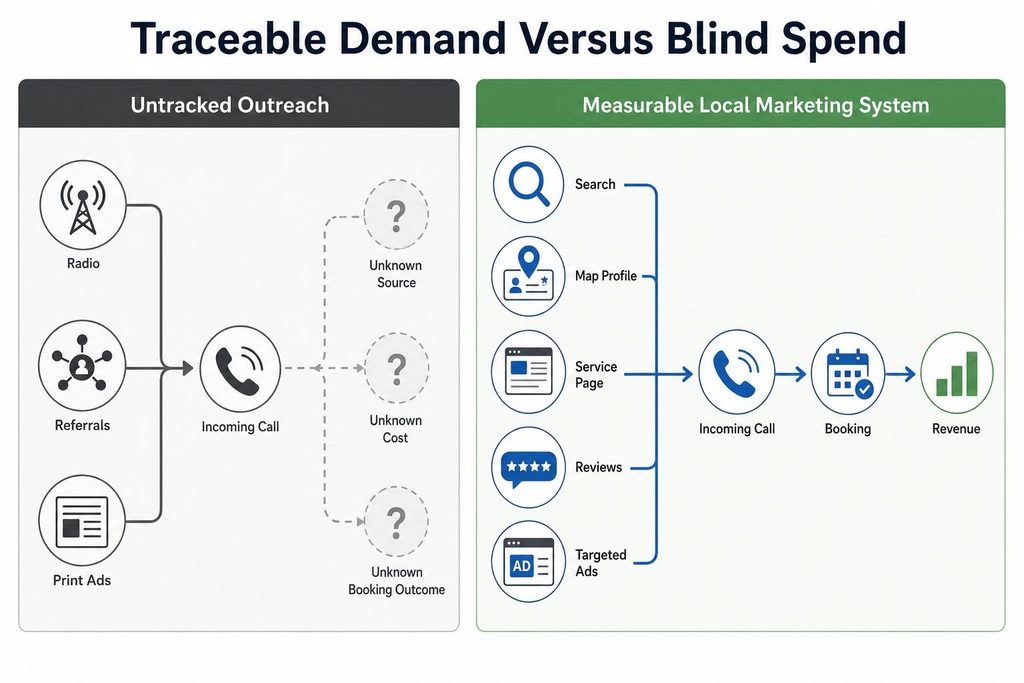
When a referral-heavy business hits a slow month, there is no way to know whether the cause was seasonal, competitive, or a breakdown in the referral chain itself, because none of it was ever measured.
That uncertainty is the actual cost of unmeasured channels, not the channels themselves.
A trackable system does not guarantee more demand. It guarantees that the demand it does produce can be examined, priced, and adjusted.
The contrast holds across every axis that matters to a payer.
- Local reach through referrals and broadcast depends on personal networks and a broadcast area that is hard to size, while a digital system defines reach through service-area targeting and local search visibility that can be measured directly.
- Intent stays unknown until the caller states a need on the phone, whereas search terms and the page a visitor lands on signal that need in advance.
- Trust in a word-of-mouth reputation is real but not independently verifiable, while review volume, ratings, and profile detail are visible to anyone before they ever make contact.
- Contact attribution is the sharpest divide of all: traditional channels leave no record of which effort produced a given call, but a digital system tags every call and form to the campaign or channel that generated it, and can link the eventual booking back to the page that started it.
The Right Marketing Question Is Whether Qualified Calls Can Be Booked and Traced
Before any budget is approved, the useful question is not “will this get us more exposure.” It is narrower and more uncomfortable:
- which services and which service areas actually need more demand right now,
- are the phones answered well enough to convert the calls that already come in,
- and can a qualified call be traced from its source all the way to a booked job.
Those three tests expose most of the weak spending decisions before they happen.
A campaign built to drive calls for drain cleaning in a territory that is already fully booked does not add revenue, it adds hold time. A campaign that drives calls to a phone line that goes to voicemail after five rings does not produce bookings, it produces missed opportunities with a cost attached.
The vocabulary for judging performance is not complicated, even though it gets treated that way.
- Website traffic and impressions describe how many people saw something, and click-through rate describes how many of them acted on it.
- Conversion rate describes how many of those actions became a contact, while cost per lead and lead quality describe what each contact cost and whether it was worth answering.
- Return on ad spend and customer lifetime value describe whether the whole exercise made money once, and over time.
- Conversion tracking and Google Analytics are the plumbing that connects these numbers to an actual source.
No single one of these proves profitable growth. A low cost per lead on leads that never book is not a win. A high conversion rate on a trickle of traffic is not a growth engine.
The numbers only mean something read together, against the operational question of whether the business can fulfil what it is generating.
Local Search Credibility Produces the Strongest Foundation for Plumbing Demand
Most homeowners facing a leak, a clog, or a planned bathroom renovation start with an online search. What they see there, a business’s local listing, its map presence, its reviews, and its stated service area, determines who gets called before any conversation happens.
That makes local search standing the layer beneath every other marketing activity, not one tactic among several.
Google Business Profile accuracy, ordinary local SEO discipline, credible reviews, active reputation management, and honest service-area targeting work as one system because they are all inputs to the same decision a homeowner makes in under a minute.
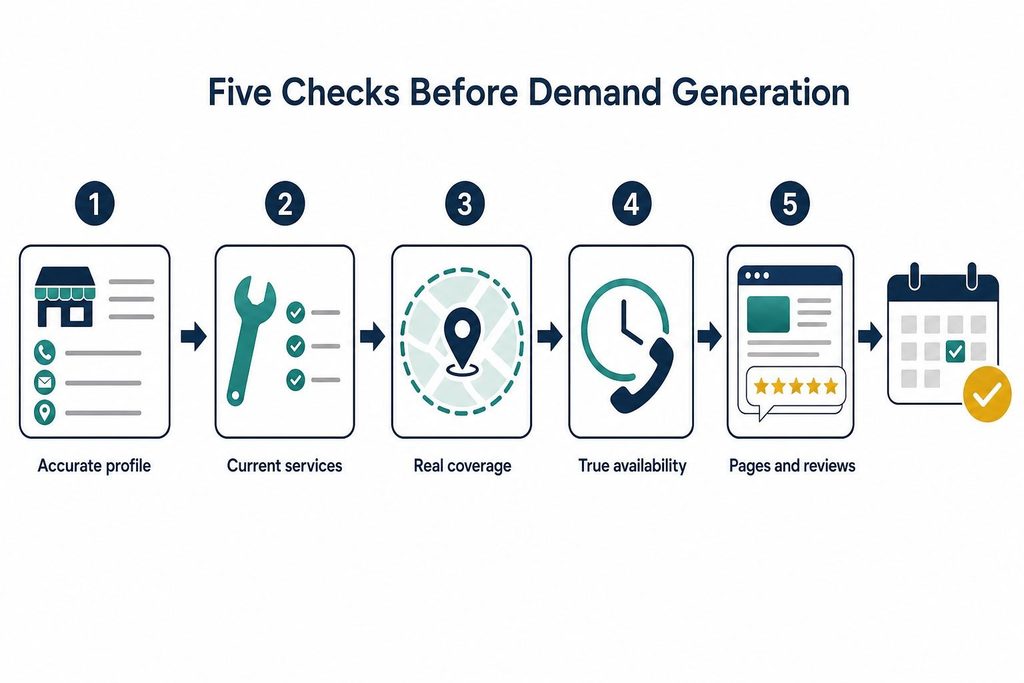
Getting that layer right is less about any single tactic and more about sequencing the checks in the right order.
- Verify profile accuracy first. Business name, address, and phone number should match exactly across the profile, the website, and any directory listing, since mismatches are what erode trust before a call is even placed.
- Confirm service categories reflect current capability. List what crews can actually do today, not services dropped last year, so the calls that come in match the work that can be delivered.
- Set service-area boundaries to real staffing. Zones should reflect what the business can realistically cover, not an aspirational radius that generates calls no one can reach in time.
- Check hours and emergency availability. These should reflect actual after-hours capacity rather than a default template carried over from setup.
- Only then, build out service pages and review collection, since profile accuracy is the foundation the rest of the system depends on.
Service Pages Have To Separate Emergency Intent From Planned Projects
A person with a burst pipe at midnight and a person planning a kitchen remodel in three months are both searching, but they need different pages, different language, and a different call to action.
A page built for emergency intent should lead with response time and after-hours availability. A page built for planned work should lead with process, materials handled, and scheduling flexibility.
Collapsing both into one generic services page tends to underserve both.
Review collection sits alongside these pages as the third leg of the same system. Reviews function as a trust signal only if they are current and specific, and only if the response pattern to negative ones is honest rather than defensive.
That means:
- timely requests sent after job completion rather than months later,
- responses to negative reviews that acknowledge the issue rather than dispute it publicly,
- and periodic checks that review sentiment still matches actual dispatch quality on the ground.
A Full Funnel Turns Attention Into Calls, Bookings, and Repeat Demand
The path from a stranger’s search to a repeat customer follows a sequence, and skipping a stage in that sequence is usually where budget gets wasted.
- It starts with awareness and local discovery, where a homeowner first sees the business through search results or map placement.
- It moves to confidence through proof, where reviews, profile completeness, and clear service pages either support the click or lose it.
- Then comes low-friction contact, where a phone number, a form, or a click-to-call button either makes reaching the business easy or adds unnecessary steps.
From there the sequence depends on response speed and booking follow-through, and this is where emergency-intent and planned-project searches diverge sharply.
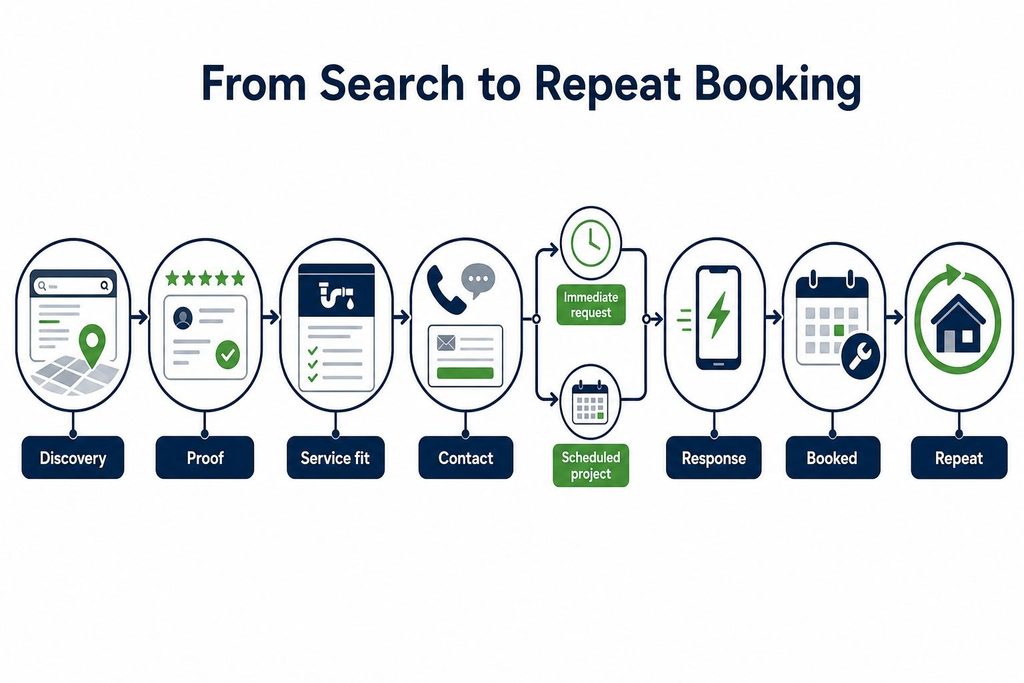
An emergency search that goes unanswered for twenty minutes will simply move to the next result. A planned-project inquiry has more patience but expects a clear next step, a quote timeline, or a scheduled visit.
The final stage, follow-up or retargeting where the job did not close immediately, and repeat business once it did, is where local SEO, profile upkeep, service pages, reviews, and targeted paid search stop being separate line items and start behaving as one connected sequence.
The benefits worth naming directly are:
- stronger market reach,
- more targeted customer acquisition,
- greater local credibility,
- lead generation that can actually be measured,
- and the discipline that comes from being able to see which stage of the sequence is losing demand.
Conversion Discipline Determines Whether Marketing Spend Reaches the Dispatch Board
A campaign cannot compensate for a phone that rings out, a callback that arrives two days late, service information that no longer matches what the crew does, thin or outdated reviews, or a calendar with no open slots to offer.
Spend generates calls. Everything after the call is decided by operations, and that is where a large share of marketing budget disappears without anyone noticing where it went.
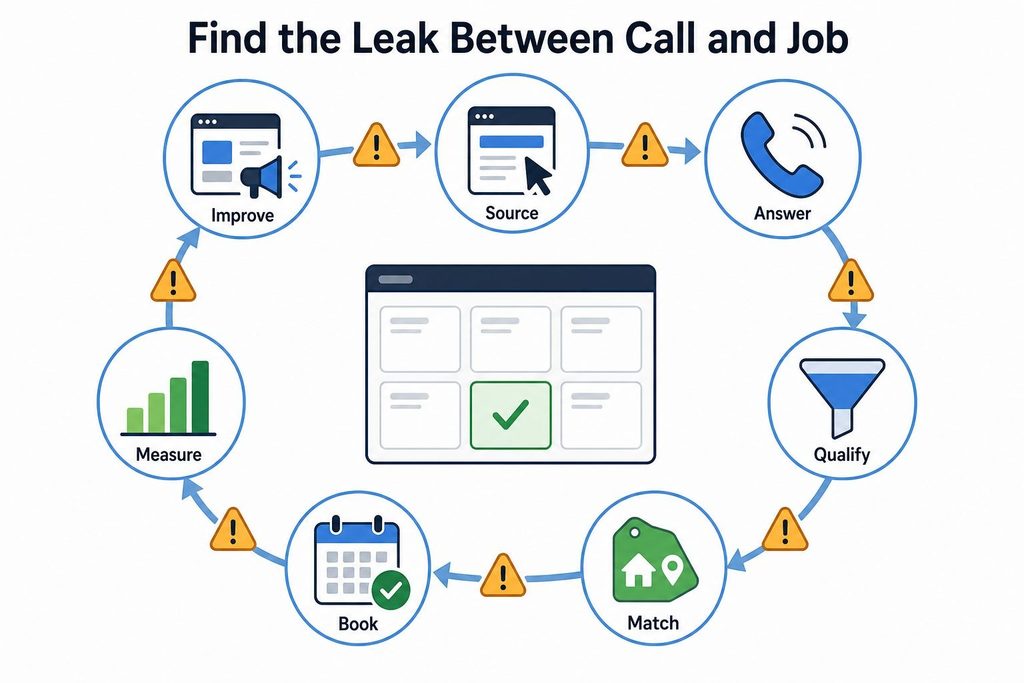
A recurring audit closes that gap. It should:
- confirm source capture on every call and form submission against the channel that produced it,
- check call-answer rate and booking rate separately, since a high answer rate paired with a low booking rate points to a sales problem rather than a marketing one,
- tag service and area on every inquiry so demand can be sorted by what was actually requested and where,
- separate real jobs from wrong numbers, out-of-area requests, and price-shopping calls before anyone calls a lead qualified,
- compare cost against revenue per channel rather than as a single blended number,
- and feed whatever the audit finds back into the pages and campaigns it examined, or the exercise was just bookkeeping.
Marketing spend is defensible when it is tied to capacity, lead quality, close rate, revenue, and customer lifetime value.
It is not defensible when the only number in the report is clicks, because clicks do not pay for trucks.
A Test Budget Should Be Set by Capacity and Attribution, Not a Benchmark
A workable test budget starts from four decisions, not a percentage pulled from a benchmark:
- the service capacity actually available to fill,
- the target service mix and areas worth pursuing,
- the qualified-lead cost the business can tolerate,
- and the tracking needed to connect that spend to booked revenue.
The supplied research does not support a single agreed definition or number for the so-called 3-3-3 rule in marketing, and it should not be treated as a formula.
Without a stated definition, a measurement method, and the specific business context it applies to, a rule like that is a placeholder, not a budget.
What to Do in the First Forty-Eight Hours
Before any new dollar is committed, the next two days should go to establishing a baseline, in this order.
First, audit the Google Business Profile, listed service areas, service pages, review activity, and call-answer coverage.
This comes first because none of the demand a campaign generates matters if it cannot convert once it arrives, and every hour spent on new spend before this audit risks paying to fill a leaking bucket.
Second, pick one service area and one capacity priority, and record the current source-to-booking baseline for it.
This comes second, once the conversion layer is confirmed sound enough to trust, because every future spending decision needs something to be measured against, and a baseline set before the audit would just be measuring the same leaks.
Complete both steps before approving any new marketing spend. It costs nothing but time, and it is the only way to know, a month from now, whether the next dollar spent actually moved the dispatch board or just moved the traffic numbers.