

What High-Growth Plumbing Businesses Expect from Specialized SEO Partners
Can the agency in front of a plumbing business show, with a screenshot rather than a slide, which service-area query moved a client into the local pack and what that move was worth in booked jobs?
Most proposals never get asked that question directly.
They get judged on tone, on the polish of the deck, on whether the account manager sounds confident about “visibility” and “authority.” None of that is evidence. It is packaging, and packaging tells an evaluator nothing about whether the same firm has ever turned a plumbing search result into a paid invoice.
What follows treats every claim an SEO partner makes as something to be checked, not believed.
What Makes Plumbing SEO Different From General Marketing Support?
A plumbing business lives on two kinds of demand at once: the burst search from someone with water on the floor right now, and the planned search from someone comparing quotes for a water heater replacement next month. Both have to convert into a call or a form, tied to a specific service area, because a plumber cannot serve a lead three counties away. That single fact changes what “ranking well” has to mean.
Generic marketing support tends to treat search as a content problem. Specialized plumbing SEO has to treat it as an operational problem with several moving parts that all have to work together.
- Local SEO tuned to service-area radius.
- A real SEO audit of the existing site.
- Keyword work that separates emergency intent from research intent.
- On-page service pages built for each trade and each town.
- Technical foundations that don’t choke a mobile page load.
- Content that supports those pages rather than replacing them.
- Link building that a plumbing brand can actually earn.
A proposal that promises rankings without naming which of those seven pieces it is actually doing has told the evaluator nothing verifiable yet.
What Is at Risk When a Plumbing SEO Proposal Cannot Be Verified?
Unverified work has a predictable failure mode: activity that looks busy and produces no qualified leads. Blog posts get published, a few keywords creep up a few positions, and six months later the owner is looking at a report full of green arrows and an unchanged number of booked jobs. The arrows and the jobs were never connected in the first place, and nobody built the connection into the reporting.
A report that lists work completed without linking it to a lead, a call, or a booked job is not a performance report. It is an activity log.
Local visibility claims carry the same risk if they can’t be checked against something concrete, like a saved screenshot of a map-pack result for a defined service-and-location query, taken on a known date. Without that anchor, “we improved your local visibility” is an assertion, not a finding.
Competitor analysis belongs in the evaluation baseline for the same reason, but only if it is built from the business’s own market. General SERP research covering one unnamed location and one language proves that competitive gaps exist somewhere; it proves nothing about a specific city, county, or regional plumbing market until an agency runs that analysis against the actual service area under consideration. An evaluator should ask to see that market-specific work before accepting any competitive claim at all.
What Evidence Should a Plumbing Business Require Before Signing?
Every criterion below is meant to be scored pass or fail against evidence the agency actually hands over, not against how convincingly they talk about it in a meeting. A firm that cannot produce the artifact fails that row, regardless of how the rest of the pitch sounds.
- Industry experience means named plumbing accounts and a description of what changed for them, not a client logo wall with no context attached. Case studies should show a starting condition against a measured outcome, with enough detail that the improvement can’t be waved off as seasonal or coincidental.
- References mean a phone number or an email an evaluator can actually use, not a quote pulled from a testimonial page. A documented SEO audit means a written report of the site’s actual condition at intake, covering technical, content, and authority gaps, not a verbal summary.
- Competitor analysis means research run against the business’s real service area, not a canned template. Transparent reporting means the evaluator gets access to the dashboards, not a monthly PDF summary built by the agency itself.
| Evaluation Criterion | Verifiable Proof | Disqualifying Absence |
|---|---|---|
| Industry experience | Named plumbing clients with dates and scope of work | No plumbing account can be named on request |
| Case studies | Documented starting metrics against measured outcomes | Only vague before/after percentages with no baseline shown |
| Client references | Direct contact for a current or former plumbing client | Agency declines to provide any contactable reference |
| Documented SEO audit | Written report of technical, content, and authority condition at intake | No audit exists, or it is a generic scan with no annotation |
| Competitor analysis | Research built against the business’s actual service area | Analysis is generic or borrowed from an unrelated market |
| Transparent reporting | Direct access to analytics and search console, not a summary only | Dashboards are agency-owned and never shared with the client |
A firm that clears every row has earned a longer conversation. A firm that fails two or more of the first four rows has not, regardless of price.
Which Services Must a Specialized Plumbing SEO Plan Include?
A scope of work should read like a list of deliverables with owners attached, not a paragraph of outcomes promised. Keyword research has to be tied to actual plumbing services and split by intent: someone searching “burst pipe repair near me” is not in the same buying stage as someone searching “tankless water heater cost.”
Each service and location combination the business actually serves needs its own page, written for that combination rather than duplicated with the city name swapped out.
- Titles and meta descriptions need documented rewrites, not a note that they were “optimized.”
Content marketing, link building relevant to home services, technical remediation, schema markup for services and reviews, and Core Web Vitals work all belong in the same document, each with a named deliverable and a way to measure whether it happened. A firm offering seo services for plumbers should be able to walk through this scope line by line and say who does the work and how its completion gets confirmed.
If a proposal describes outcomes (“improved rankings,” “more calls”) without naming the deliverables that produce them, the scope has not actually been defined yet, it has been promised.
How Should Local SEO Be Evaluated for Plumbing Demand?
Local search carries more weight for a plumbing business than for most service categories, because the map pack is often the first thing a searcher sees for an urgent query, and a business absent from it is invisible at the exact moment demand is highest.
A 2026 Google local search report from Rio SEO frames:
- Google Business Profile performance as varying meaningfully by vertical
- which means a generic local SEO claim tells an evaluator little without vertical-specific evidence attached to it.
The following checks apply directly to plumbing service-area demand and should each be answerable with a document, not a verbal assurance:
- Google Business Profile completeness: every service category, service area, and attribute filled in, with a stated reason for each category chosen.
- Citation consistency: name, address, and phone number matching across the directories the agency claims to have touched, checked against a supplied list.
- Review process: a documented method for requesting reviews after a completed job and a documented response process for both positive and negative reviews.
- Local pack visibility: tracked rank for defined service-and-location query pairs, not a single vague “local ranking” score.
- Branded versus non-branded separation: a stated method for showing how much local visibility comes from people already searching the company name against how much comes from new demand.
Two further questions decide whether these checks mean anything in practice: who actually controls the profile, and what counts as proof that visibility moved.
How Is the Google Business Profile Managed?
Ownership and access matter as much as content. The business, not the agency, should hold administrative access to its own profile, with the agency working inside it and documenting each change with a date. Category selection should have a stated rationale tied to the actual services offered, since a mismatched primary category can suppress visibility for the queries that matter most.
How Is Local Visibility Proved?
Proof means a baseline screenshot of local pack results for chosen queries, taken before work began, compared against a recurring capture on a fixed schedule. Anything short of that, a promise that “local visibility improved,” is an assertion sitting where a record should be.
Which Report Proves That SEO Is Producing Plumbing Leads?
A report worth reviewing pulls from Google Analytics and Google Search Console and connects five things in one place:
- organic traffic,
- keyword rankings,
- local pack visibility,
- lead conversion rate,
- and call tracking.
Each of those on its own is a fragment. Traffic without conversion rate says nothing about revenue. Rankings without call tracking say nothing about whether anyone picked up the phone.
The more useful distinction is between reporting of work completed and reporting of outcomes produced. A list of published pages, citations built, and links earned documents activity. A count of qualified calls, form submissions, and booked jobs, each with a stated definition, documents outcome.
Both belong in the same report, clearly separated, so an evaluator can see the work and the result without having to infer a connection that was never drawn.
Attribution windows and comparison periods need to be defined in writing: is a “qualified call” one that lasted over sixty seconds, or one manually tagged by staff. Is the reported gain measured against the prior month or the same month a year earlier. A report that never defines these terms cannot be checked against a second report six months later, which defeats the purpose of reporting at all.
How Should Plumbing SEO ROI Be Calculated and Reviewed?
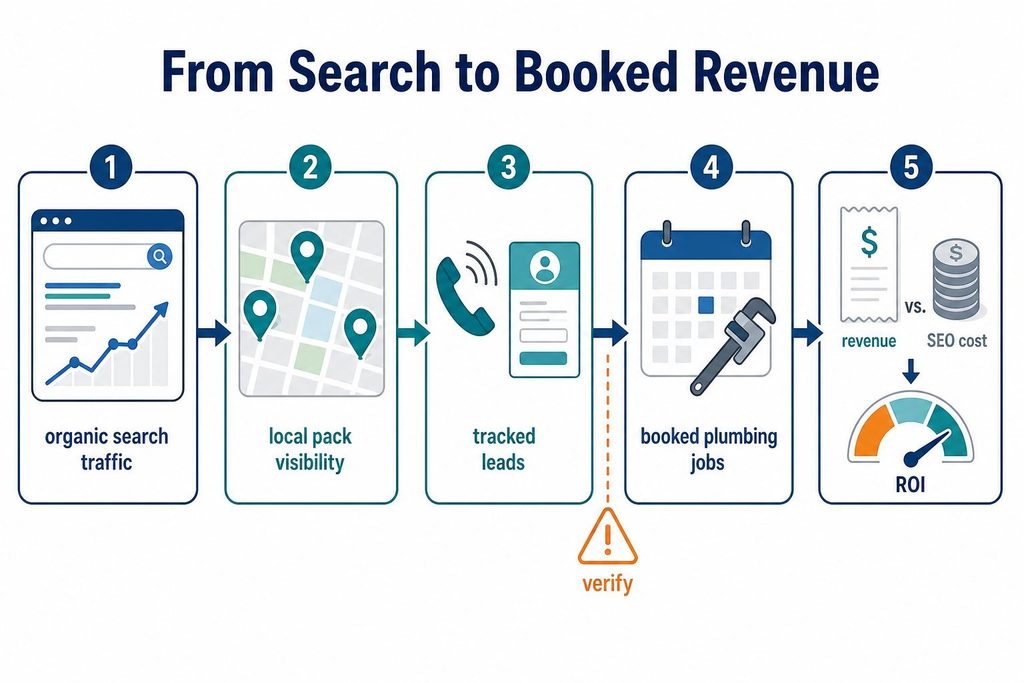
Return on investment follows a chain that has to stay intact from search to revenue:
- organic traffic feeds local pack visibility,
- visibility produces tracked leads,
- leads convert at some rate into booked work,
- booked work produces revenue,
- and revenue measured against cost produces ROI.
Breaking the chain at any link, most often between “leads” and “booked work,” leaves the ROI figure unsupported no matter how clean the earlier numbers look.
A 2026 home-services SEO article notes that mature organic local SEO leads can run in the range of $18 to $30 each, a benchmark worth holding loosely rather than treating as a guarantee. It is context for judging whether a partner’s reported cost per lead is plausible, not a number any agency should be allowed to promise as an outcome.
An agency asked for ROI should show its assumptions and its source data alongside the final figure: which leads were counted, what conversion rate was used, and where the revenue number came from. A rising keyword position, on its own, settles nothing about ROI if the lead quality behind it hasn’t been separately verified.
Position and payoff are not the same measurement.
Which Observable Facts Mean an SEO Partner Should Be Rejected?
Some signals require no judgment call, only a check against what was supplied.
- No plumbing-relevant case evidence exists, only general home-services or unrelated-industry examples.
- No SEO audit or competitor analysis can be produced in writing, only described verbally.
- No access to underlying Google Analytics or Search Console data is offered, only agency-built summaries.
- No call-tracking method is in place, so leads cannot be separated from unrelated traffic.
- No defined method exists for measuring local pack visibility against specific service-and-location queries.
- No scope is written for Google Business Profile management, citations, review response, schema, or Core Web Vitals.
- Reporting consists of ranking positions with no connection to leads, calls, or booked jobs.
Any one of these on its own is worth a hard question. Two or more together mean the evaluation is finished. The next step is small enough to do today: request the agency’s most recent anonymized plumbing report and score it, line by line, against the evidence fields above.