
Proven Outreach Strategies to Win High-Ticket B2B Construction and Property Deals
More outreach does not produce more commercial plumbing contracts. Firms that send the most proposals often win the fewest of them, because volume is aimed at whoever answers the phone rather than at the accounts that control repeatable work.
The firms with steady commercial pipeline built it before the bid ever hit a plan room. They chose a narrow buyer type, proved their qualifications in advance, and only then asked to be invited to price something.
That sequence is checkable at every stage. What follows is the order to do it in, and what to verify before moving to the next step.
Separate Commercial Opportunities From Residential Leads
A predictable pipeline means having qualified commercial accounts identified and moving before a project reaches open bid, not reacting once it is already posted. Residential leads and commercial opportunities behave differently enough that treating them as one funnel wastes estimating time on work that was never winnable.
Public bids run on fixed timelines with rigid submission rules and low margin for relationship influence. Negotiated work moves slower but rewards an established relationship with a general contractor. Service agreements and tenant-improvement work often route through a property manager or facilities director rather than an owner, with renewal cycles instead of one-time awards. Emergency facilities work gets awarded fast, usually to whoever already has approved-vendor status.
- Public bid work: long lead time, rigid approval path, heavy estimating burden, buyer is often a public agency or general contractor.
- Negotiated and service-agreement work: shorter cycle once trust exists, lighter estimating burden per opportunity, buyer is typically a property manager, facilities director, or developer.
Treating a facilities director’s service request the same as a public bid means either overbuilding a proposal that did not need it, or underbuilding one that required prequalification paperwork the firm did not have ready.
Build A Targeted Commercial Outreach System
Outreach that avoids late-stage bid chasing starts with a target narrow enough to prepare for properly, not a mailing list broad enough to feel productive.
Define Target Accounts
Pick one segment first: a property type, a project size band, or a single buyer role, such as facilities directors managing multi-tenant office portfolios. Build an account list against that segment and find out, for each account, whether work flows through a formal vendor-prequalification process or an informal bid list a purchasing contact maintains.
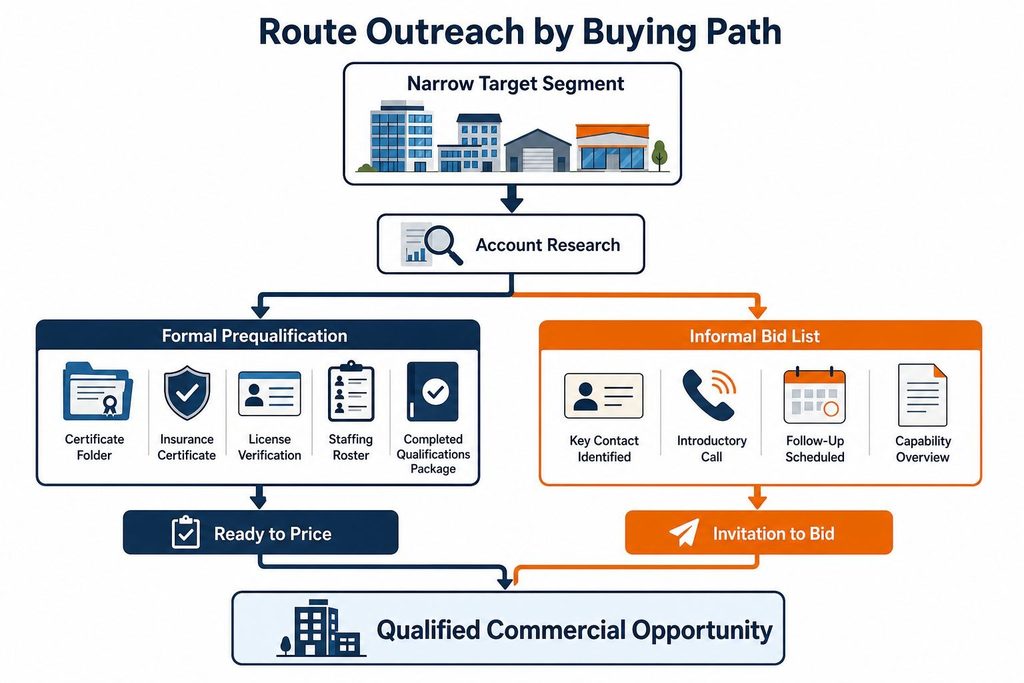
This single fact changes the entire outreach sequence. A prequalification process demands documentation before any pricing conversation happens, while an informal bid list rewards an early relationship with the person who compiles it.
Make Commercial Proof Easy To Find
Once the segment and its buying path are known, the outreach itself has three jobs: introduce the firm, prove it is qualified, and make the next step obvious.
- Email subject and opening: reference the specific property type or project band, not a generic capabilities pitch.
- Call opening: ask about their current vendor-prequalification status or bid-list process before describing services.
- Follow-up language: tie back to a specific document or credential sent previously, not a generic check-in.
- Capability-sheet sections: licensing and insurance, safety record, staffing capacity, project-management systems, and comparable commercial work.
- CRM fields: buyer role, prequalification status, document sent, date, and next scheduled contact.
- Outreach to a general contractor should emphasize trade coordination, schedule reliability, and bonding capacity, since that buyer is managing multiple subcontractors against one deadline.
- Outreach to a property manager or facilities team runs on a different logic entirely: lead with response time, service-agreement flexibility, and safety compliance, because that buyer is managing ongoing risk across an occupied building, not a single fixed deadline.
Sending the general contractor’s message to a facilities director, or the reverse, signals that the firm has not done the work of knowing its buyer.
Prove Bid Readiness Before Pricing Work
A credible proposal reduces the buyer’s risk of choosing wrong. It does not just present a lower number than the next bid. Buyers evaluating commercial plumbing vendors are protecting their own decision, and a proposal that exposes its assumptions early gives them less to worry about later.
Bidding guidance for commercial plumbing work outlines a sequence worth verifying line by line before a number goes out:
- Review the drawings and specifications in full before estimating anything.
- Perform a quantity takeoff against those documents.
- Estimate labor and material costs from the takeoff.
- Factor in overhead and profit before assembling the formal proposal.
Beyond that sequence, confirm the proposal states its scope assumptions plainly and lists required permits. It should itemize equipment and materials, and set out a timeline with a stated approach to delays. Payment terms and schedule should be explicit, not implied, and prequalification status and comparable project references belong in the package, not left for the buyer to ask about.
Facility-management procurement guidance on defining scope and evaluation criteria in advance, drawn from an [industry procurement research guide], backs this up from the buyer’s side.
A generic quote answers “how much,” while a complete proposal answers “why this firm, on this timeline, at this risk level.”
Prevent Outreach From Becoming Bid Chasing
Prevention here means staying visibly qualified between opportunities, not sending more messages. A firm that only appears when a bid is posted looks like every other vendor scrambling for the same deadline.
The next 48 hours matter more than the next 48 messages, and the order below is not arbitrary: each step depends on the one before it being done properly, not just done.
- Hours 0 to 6: Select one property type, project band, or buyer role to pursue first. Everything downstream, the proof gathered and the accounts contacted, depends on this choice being narrow enough to prepare for.
- Hours 6 to 24: Assemble or audit the qualifications package against that segment, before any account is contacted. Outreach that exposes a missing license, an expired certificate, or a thin project list does more damage than no outreach at all, so this step has to close before the next one opens.
- Hours 24 to 36: Identify a small set of accounts within the segment and record, for each, whether they run a formal prequalification process or an informal bid list. This determines what the first message says and what it asks for.
- Hours 36 to 48: Schedule the first individualized contact for each account and set a follow-up date in whatever system tracks it, so the relationship has a next step before the first conversation even happens.
The single thing to do today is choose the narrow segment. Every later decision, what to document, who to contact, and how to follow up, only makes sense once that choice is made.