

The Blueprint to Converting Browsers into High-Value Home Renovation Leads
What happens to the thousands spent on a kitchen-and-bath photo gallery when the visitor who finds it on a phone cannot find a way to ask for a quote?
That question rarely gets asked before the invoice for a new contractor website gets signed. It gets asked afterward, usually by someone staring at a form-submission count that never matches the traffic report sitting next to it. The gap between the two numbers is where renovation budgets leak, and closing it takes more discipline than another round of nicer photography.
Why Does General Contractor Website Design Determine Whether Renovation Interest Becomes a Lead?
A renovation website is not a portfolio with a phone number attached to it. It is a lead-capture system, and every part of it either advances a visitor toward a quote request or gives them a reason to leave. That distinction matters because renovation buying decisions are large, considered, and researched on a phone before they are ever discussed by email or in person.
General contractor website design decisions made early, before a single service page is written, set the ceiling on how many of those researchers ever become enquiries. A homeowner comparing three renovation firms on a Saturday morning is not going to type a message on a site that fights them.
What The Mobile-First Impression Has To Do
A 2026 analysis of more than fifteen construction company websites found that 92 percent of the traffic reaching them arrived on a mobile device, which means the site’s real first impression is a small screen, not the desktop mockup approved in a meeting. Responsive design and mobile optimization stopped being a technical nice-to-have some time ago.
The hero image at the top of the home page is doing one job on that screen: telling the visitor, in under two seconds, that this firm does the kind of work they are looking for. If it loads slowly, crops badly, or buries the point under a paragraph of agency copy, the visitor’s attention is already gone before the call-to-action button ever gets seen.
What The Quote-Request Path Has To Do
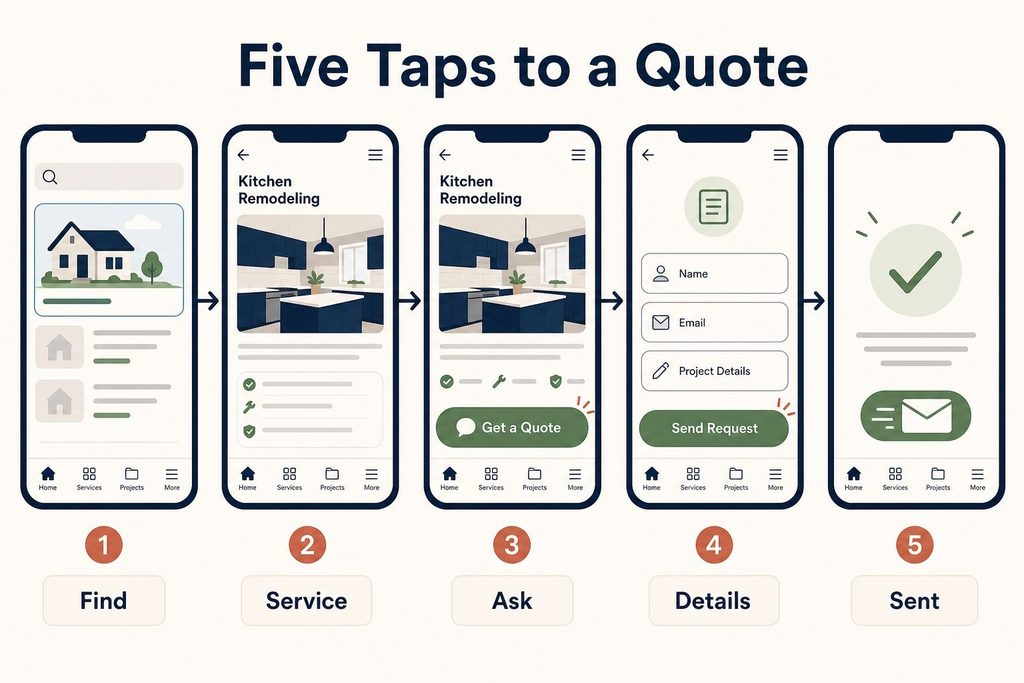
Attention that survives the hero image still has to travel somewhere. That means a visible call-to-action button, a contact form that does not demand more information than a first enquiry warrants, and a consistent route to a quote request from every service page, not just the home page. Conversion rate optimization is nothing more exotic than reducing the number of decisions and taps standing between interest and submission. A homeowner who has to hunt for the contact page on a renovation site has usually already opened a competitor’s tab.
Which Website Problems Waste Home Renovation Enquiries?
Symptoms and causes get confused constantly in these conversations, usually because the symptom is the only thing visible in a bounce-rate report. The underlying cause sits one layer down, in a specific design or content decision nobody has revisited.
The pattern generally breaks down into a short list of recurring issues:
- Poor mobile friendliness: menus that require pinching to tap, forms that misalign on smaller screens. The visible symptom is a spike in mobile bounce rate; the cause is a template never properly tested past the desktop preview.
- Slow page load time: a 2026 review of contractor website performance ties load times under three seconds to stronger engagement and conversion outcomes on construction sites. Anything meaningfully slower than that becomes the reason a visitor leaves before the page finishes rendering.
- Unclear navigation menu: too many categories, or renovation services buried two clicks deep, cost attention that a homeowner was never going to spend generously.
- Weak service-page clarity: vague copy that never names the specific renovation service, area, or price range being addressed, so the visitor cannot confirm this firm does what they need.
- Absent proof: no current-work examples, no client testimonials, nothing that answers the trust question a stranger asks before handing over contact details.
- Fragmented contact paths: three different ways to enquire, none of them consistent, none of them monitored at the same speed.
Each of those degrades lead quality even when raw traffic looks healthy, because the visitors who persist through friction are not necessarily the ones ready to commit.
What Should Be Audited Before Paying for a Contractor Website Redesign?
Before any redesign proposal gets approved, the cheapest possible diagnostic is a no-cost crawl of the existing site: the home page, every service page, the portfolio gallery, the contact forms, and the mobile path a homeowner would actually take. Google Analytics shows where visitors are dropping off. Google Search Console shows what they searched for to arrive. Google PageSpeed Insights shows whether load time is the reason they left before either of those tools ever recorded a decision.
That audit is best run against a compact lens rather than a checklist pulled from nowhere. The often-cited seven C’s of website design, clarity, consistency, credibility, content, compatibility, communication and conversion, work reasonably well here as an audit frame rather than as universal law: they force the question of whether each page element is doing a job, not just occupying space.
The same applies to the commonly listed five essential website elements: navigation, content, visual design, functionality and speed. Neither framework replaces judgment, but both stop the audit from becoming a subjective argument about taste.
What the audit reveals should sort remedies into two categories immediately.
- Fixing broken image alt text, tightening a menu, rewriting a vague service page, or correcting a misconfigured contact form is free configuration work, achievable without a developer.
- Restructuring the entire information architecture, moving off an inflexible template, or building custom location pages is scoped paid work.
A template is adequate for firms with a small, similar service list; custom design or specialist website services earn their cost only once service complexity, or the volume of location pages needed, outgrows what a template can hold cleanly.
Which Page Elements Give a Contractor Website Its Best Chance to Convert?
Once the audit identifies where friction sits, the remedy has to be matched to the right page element rather than applied as a blanket redesign. Some fixes are content work a business owner can do without a developer. Others require a paid, scoped implementation because they touch structure, not just wording.
| Page Element | Visitor Decision It Supports | Remedy Category |
|---|---|---|
| Hero image and promise | Is this firm right for my project | No-cost: content/image swap |
| Service pages | Do they do exactly what I need | No-cost: copy rewrite |
| CTA button and contact form | Can I act on this right now | Paid: form/UX scoped build |
| Portfolio gallery | Can I trust the quality shown | No-cost to moderate: content gathering |
| Client testimonials | Have others been satisfied | No-cost: content collection |
| Quote-request flow | Is asking for a quote easy | Paid: flow redesign |
What Proof Content Has To Do
The same 2026 construction website review behind the mobile-traffic figure also reports that a portfolio holding 15 to 30 completed projects helps build credibility with a visitor comparing firms. That number is not a universal rule for every renovation business, but it points at something real: a gallery with three finished jobs from years ago reads as inactivity, whichever way the homeowner interprets it. Testimonials do similar work from a different angle, confirming the experience rather than just the output.
What Lead Capture Has To Do
The same source ties clear calls to action and well-placed quote forms to a 55 percent lift in lead generation on the sites studied. That figure describes the sites reviewed there, not a guaranteed outcome for every renovation business, but it supports a conclusion that should already be obvious: a beautiful portfolio next to a buried or clumsy contact form is wasted design spend.
The CTA and the proof have to sit near each other, not compete for the same visitor’s patience in sequence.
How Can Mobile-First User Experience Design Remove Friction From the Quote Path?
Once the audit and the element-level review point at friction, the fix runs in a specific order, starting with structure, not decoration. Responsive design means the layout adapts, but user experience design means the interaction itself makes sense on a small screen: buttons sized for a thumb, forms that do not force zooming, text that does not require pinching to read.
What Navigation and Contact Paths Have To Do
A concise navigation menu, four or five categories rather than twelve, gets a homeowner to a relevant service page faster than a menu built to satisfy every internal department. A visible contact route belongs on every key page, not the dedicated contact page alone, because a visitor who has just read a kitchen remodeling page should not have to hunt for a way to ask about it.
What Speed and Accessibility Have To Do
Accessible controls and properly labeled form fields are not a compliance afterthought. They are what lets a visitor using a screen reader, or simply typing quickly on a small keyboard, actually complete a submission instead of abandoning it.
Image handling matters here too: large, uncompressed photos are usually the single biggest cause of slow load time on a renovation site loaded with portfolio images. Some of this, image compression, menu simplification, form-label correction, can be configured internally. Restructuring the page templates to be accessible and responsive at a structural level more often needs developer or design-service scope.
How Should SEO and Local Visibility Be Built Into Contractor Service Pages?
Visibility that lands somewhere other than a working conversion page is wasted effort, which is why local SEO and page structure have to be planned together rather than treated as separate projects.
The sequence generally runs in this order:
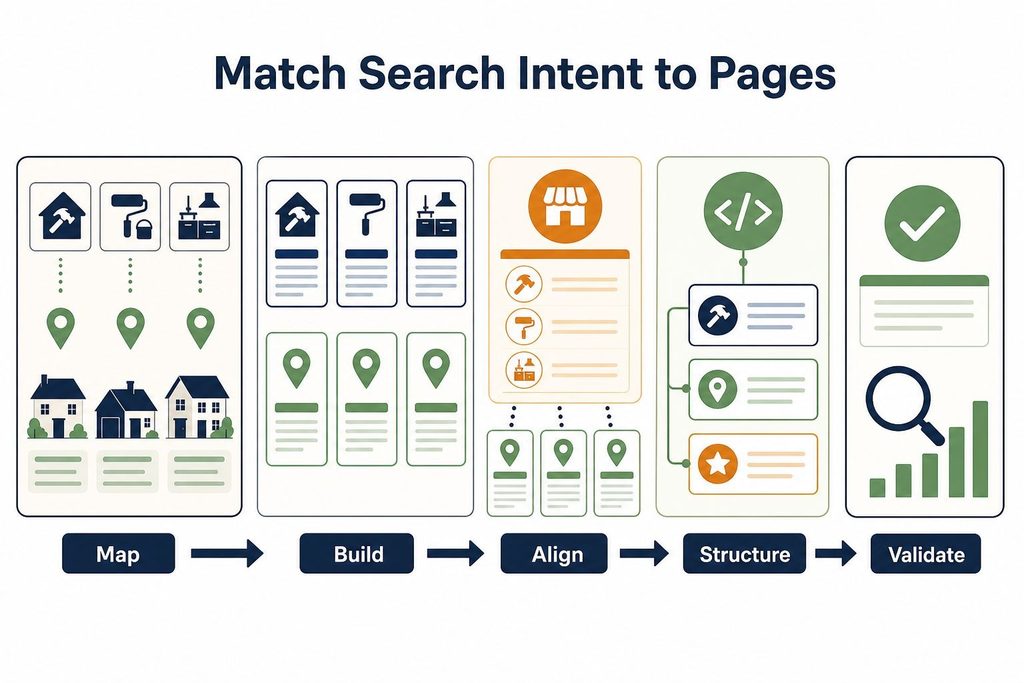
- Map core services and service areas so it is clear which renovation categories and which towns or neighborhoods the business actually serves.
- Build focused service and location pages rather than one page trying to describe everything the firm does everywhere it operates.
- Align service-page topics with Google Business Profile categories, since profile categories that do not match the content on the linked pages weaken the connection between the search listing and the site itself.
- Add schema markup so search engines can read structured details about services, service areas, and reviews rather than inferring them from unstructured text.
- Validate indexing and search queries in Google Search Console, confirming the pages built in steps two and three are actually being found for the terms a homeowner would use.
None of this guarantees a ranking position, and no claim here should be read as one. What it does is remove the more common reason a technically sound page never gets found: a mismatch between what the business profile says and what the linked page actually contains.
For contractors weighing whether to rebuild on a flexible platform to support this kind of page structure, a 2026 contractor website-builder guide names WordPress and Elementor as the most flexible open option among the platforms it reviewed, with hosting and plugin costs sitting well below a full custom build.
What Can Be Done in the First 48 Hours to Stop the Same Lead Gaps Returning?
The audit only has value if it produces action before the details are forgotten in a follow-up meeting three weeks later. Three moves matter here, and they come in this order because each one depends on the one before it.
- First, within the first day: capture a mobile baseline. Current numbers from Google Analytics, Google Search Console, and Google PageSpeed Insights get recorded and saved somewhere that survives past this week. This step comes first because it is what proves whether anything done afterward actually changed something, rather than relying on impression; without it, every later fix is a guess about its own effect.
- Second: walk the journey. Test one representative service-to-contact path exactly as a homeowner would, on a phone, from a search result to a submitted form. This has to follow the baseline and precede any repair, because it is the only way to find where the path actually breaks rather than where it is assumed to break. Wherever it fails, fix the cheapest blockage first: a mislabeled button, a form field that will not accept a phone number, a menu item that leads nowhere useful.
- Third, once the obvious blockage is cleared: list what is missing for the deeper remedy. A current-work portfolio example that has not been photographed yet, a testimonial that was promised but never collected, a service area that is served but never mentioned, a quote-form field that asks for the wrong information first. This step comes last because it produces the brief for a scoped paid remedy, and that brief is only worth writing once the free fixes are already done and the baseline shows what is left to move.
From there, the discipline is ongoing rather than a one-time event.
–
- Conversion rate,
- bounce rate,
- mobile friendliness,
- page load time,
- quote requests, and
- current-work freshness
deserve a recurring check, so that:
new content, social-media posts, and portfolio additions: build on a site that already works, instead of promoting: one that loses the visitors it attracts.
The one thing worth doing today, before anything else on this list: pick a single service page, follow its quote path on a phone from search to submission, and write down exactly where it breaks.