

Why General Contractors Are Wasting Money on Standard Ad Agencies
A regional remodeling company spent four months paying an advertising agency to run search ads and social posts. The reports looked healthy: impressions climbing, clicks up, cost per click trending down. Nobody on the agency side, and nobody on the contractor side, could say how many of those clicks turned into a booked estimate, let alone a sigWhy General Contractors Are Wasting Money on Standard Ad Agencies
A regional remodeling company spent four months paying an advertising agency to run search ads and social posts. The reports looked healthy: impressions climbing, clicks up, cost per click trending down. Nobody on the agency side, and nobody on the contractor side, could say how many of those clicks turned into a booked estimate, let alone a signed job.
The owner found out only when a bookkeeper asked why marketing spend had doubled while sold work had not moved.
That gap between activity and outcome is not a one-off failure. It is the default result of hiring a marketing partner that measures the wrong thing, because the wrong thing is easier to report.
This happens because standard advertising agencies are built to optimize the metrics that generalize across industries: traffic, click-through rate, cost per lead. None of that maps cleanly to a construction business, where a “lead” might be a homeowner three states outside the service area, a job too small to cover overhead, or a tire-kicker who never intended to sign a contract.
Why Do Standard Ad Agencies Miss What Makes Contractor Marketing Work?
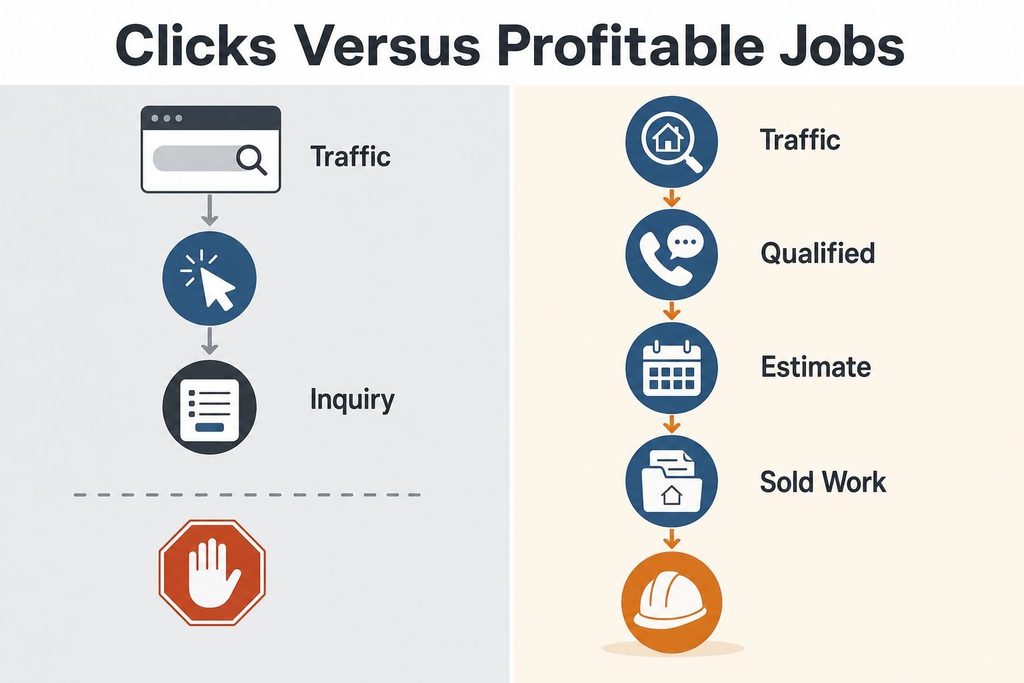
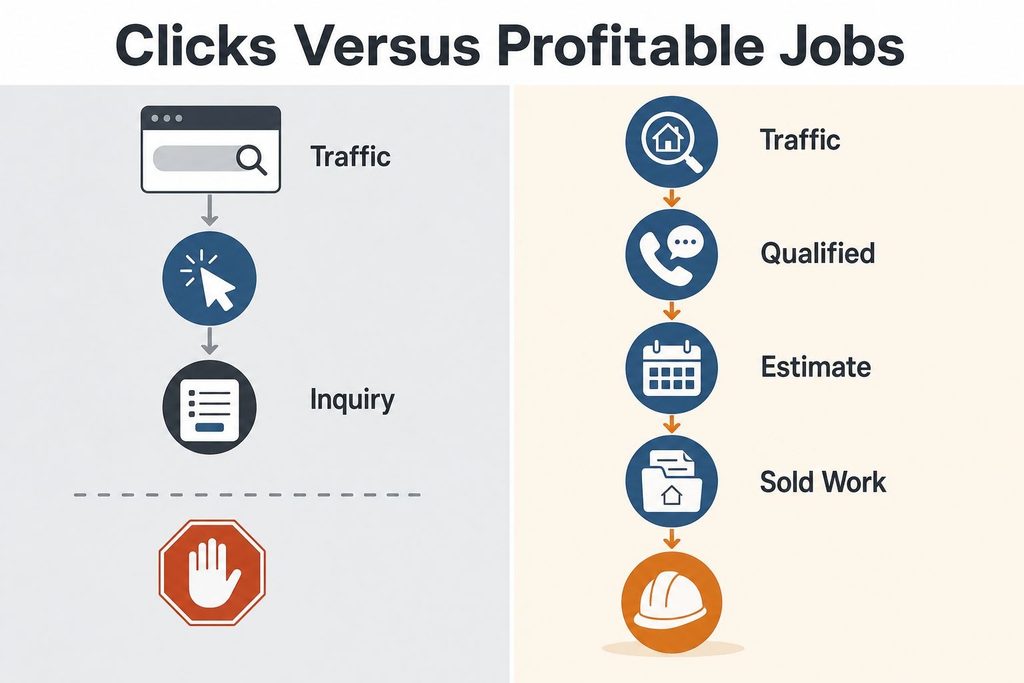
The failure is structural, not accidental. A standard agency reports success the moment a form fills or a phone rings, because that is where its accountability ends.
It has no visibility into what happens after the call, whether the estimator drove forty minutes to a house outside the service radius, or whether the job size fell below the minimum needed to be worth booking. The desired result for a contractor is not more inquiries. It is a predictable flow of qualified opportunities that convert into profitable, schedulable work.
That distinction changes what should be measured, and by whom.
| Comparison Point | Specialized Contractor Marketing Agency | Standard Advertising Agency |
|---|---|---|
| Profitable-job definition | Builds targeting around job value, trade capacity, and margin thresholds set by the contractor | Optimizes for lead volume or cost per click, independent of job profitability |
| Service-area and local intent | Structures campaigns around drivable radius, permit jurisdictions, and neighborhood-level demand | Runs geographic targeting as a setting, not a strategic input tied to crew logistics |
| Reviews and reputation | Treats Google Business Profile activity and review generation as core lead-quality signals | Treats reviews as a reputation-management add-on, separate from lead campaigns |
| Estimate handoff | Tracks whether inquiries convert to booked estimates and flags mismatched leads | Stops measuring once the call or form fill happens |
| Outcome reporting | Reports calls, qualified opportunities, estimates booked, and closed-deal source where data allows | Reports impressions, clicks, and cost per lead as the endpoint |
The pattern across every row is the same. One side of the table treats the estimate and the sale as the object of the campaign. The other treats the click as the object, and everything downstream as someone else’s problem.
A contractor comparing proposals should ask, line by line, which of those two postures each finalist actually operates from, not which one it claims in a pitch deck.
What Does the Wrong Agency Actually Cost a General Contractor?
The cost is not just the retainer. Wasted media and management fees are the visible layer, but the deeper cost sits in estimator time. Every unqualified inquiry that reaches an estimator, whether by phone, form, or chat, consumes hours that could have gone to a viable bid.
A crew’s or estimator’s capacity is finite. A stream of leads outside the service area, below minimum job value, or outside the trade’s actual scope consumes that capacity without producing revenue, and the drain rarely shows up until someone checks the numbers against sold work.
There is a useful distinction hiding inside “leads” that most reporting collapses into one number. Traffic, inquiries, qualified leads, booked estimates, sold jobs, and profitable work are six different stages, and a loss at any stage looks identical in a summary report that only counts the first two.
Missed local visibility compounds the problem in a way that rarely shows up in a monthly report. If review generation and Google Business Profile activity are neglected while ad spend runs, the contractor loses ground competitors are actively closing.
Reputation risk follows the same path: a generic agency running ads with no connection to actual review management can amplify visibility for a listing that is thin or outdated, sending more scrutiny toward a weaker storefront.
How Should A Contractor Define The Work Worth Marketing Before Comparing Agencies?
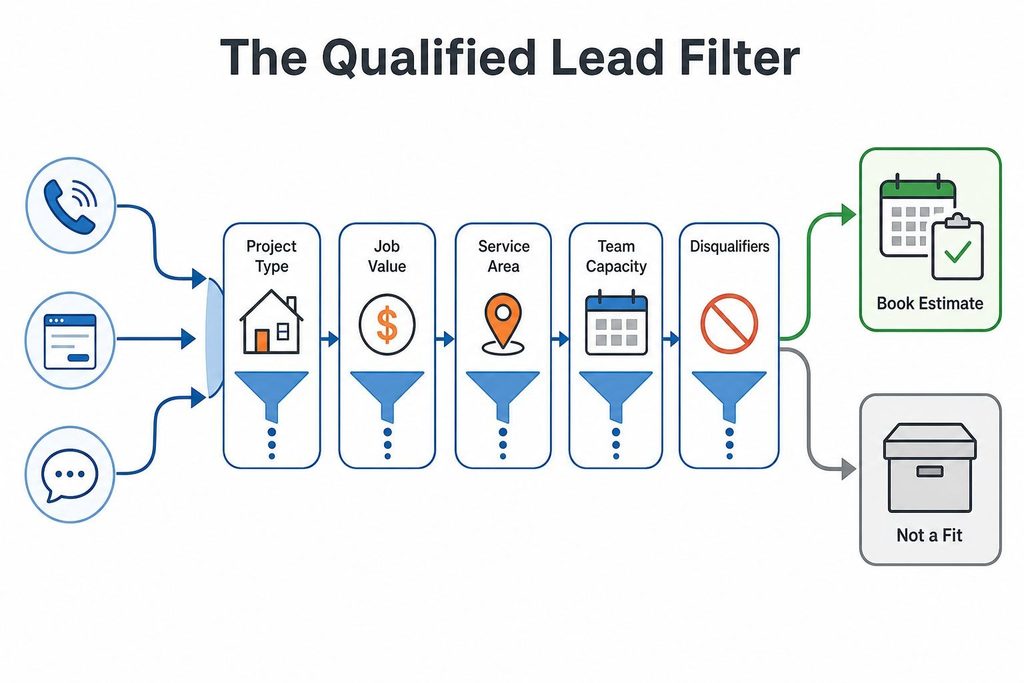
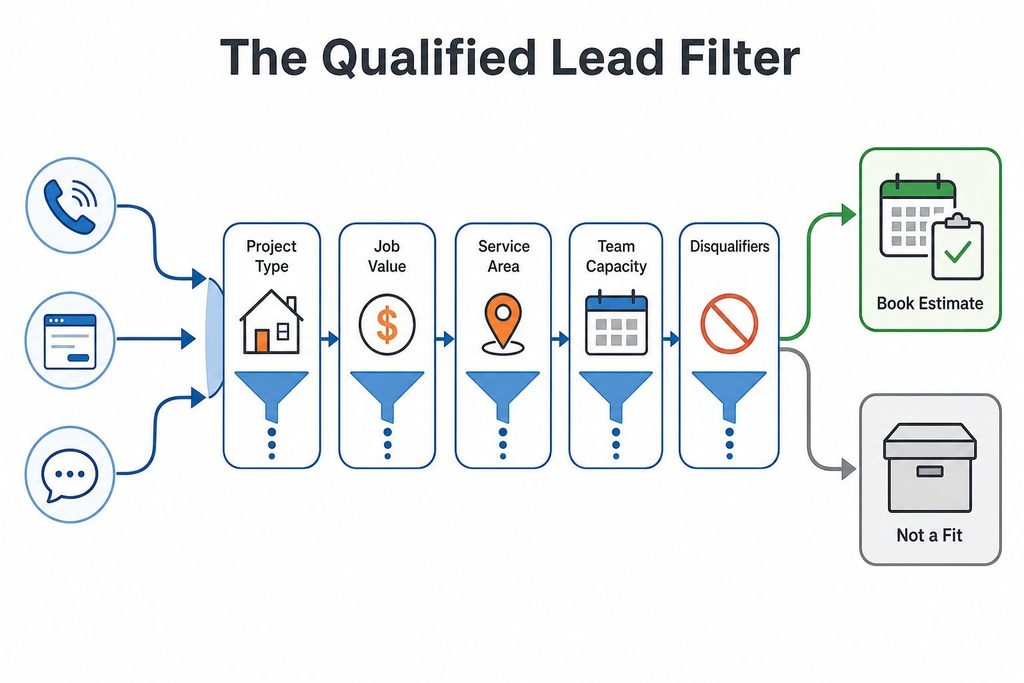
Before any proposal gets evaluated, the contractor has to write down what a qualified lead actually is, in terms specific to the business, not the industry. That document does not need to be long, but it needs to exist before a single agency call happens.
- Ideal trade and project type the business is actually staffed and equipped to deliver profitably right now.
- Minimum job value or margin threshold below which an estimate is not worth booking.
- Service areas, defined by drive time or jurisdiction, not a radius drawn for convenience.
- Capacity and schedule limits, including how many estimates the team can realistically handle per week.
- Disqualifiers, such as job types the business no longer takes or areas it has stopped serving.
- A working definition of a qualified estimate, stated in plain terms an agency can be held to.
Bid Work Versus Negotiated Work
A contractor bidding competitively against other firms needs volume and speed in the qualification process, since many bids will not convert regardless of lead quality.
A contractor doing negotiated, relationship-driven work needs fewer, better-vetted leads, and a very different tolerance for cost per qualified opportunity. Treating both under one lead definition guarantees the wrong metric gets optimized for one of the two models.
How Trade, Job Type, and Area Change Qualification
A solar installer, a roofer, and a flooring contractor do not share a sales cycle, a service radius, or a seasonal demand curve, and none of them should be evaluated against a single generic qualification bar.
Solar sales often involve financing conversations and longer decision windows. Roofing work is frequently storm-driven and time-compressed. Flooring projects tend to be scheduled around other renovation work. Qualification criteria need to reflect that, not borrow a template built for a different trade entirely.
Which Contractor Marketing Capabilities Should An Agency Connect To Qualified Leads?
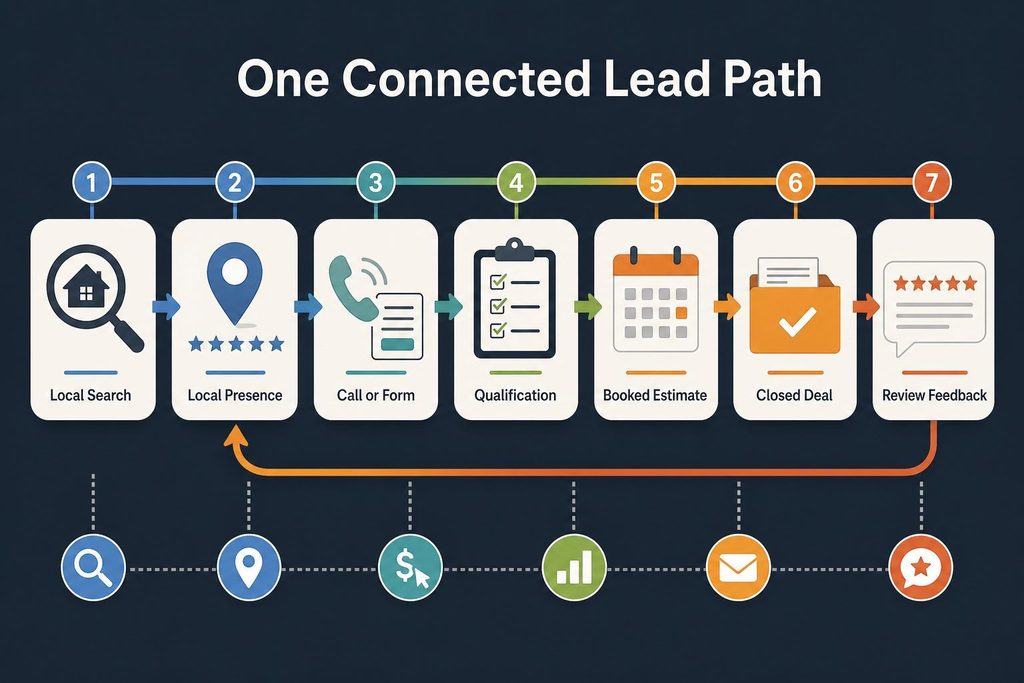
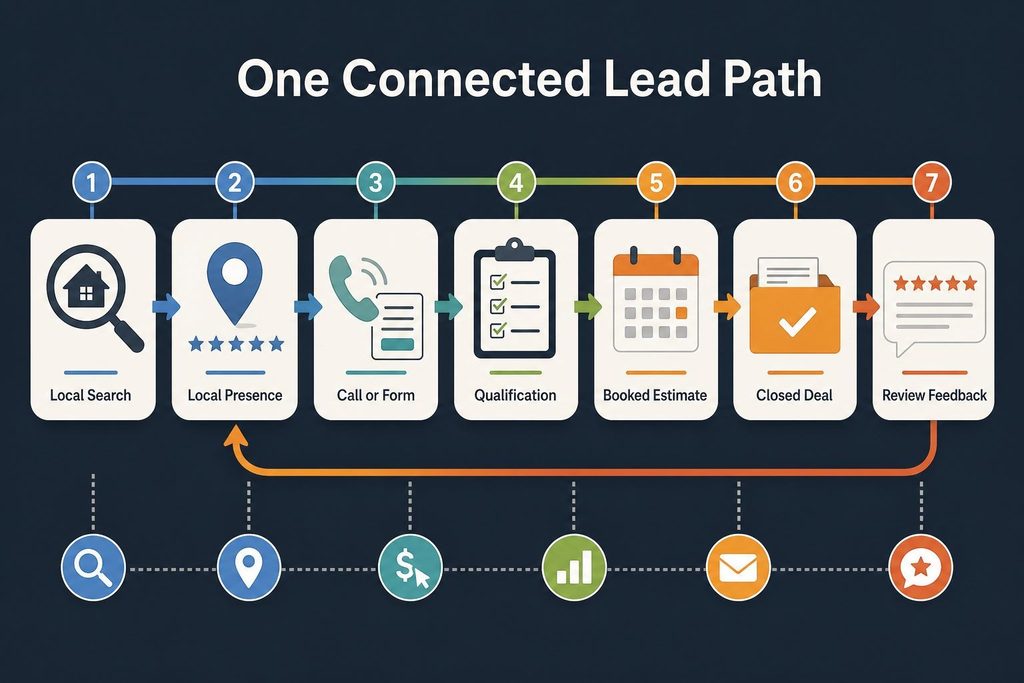
A lead path has stages, and an agency worth paying should be able to describe every one of them without switching topics. It starts with local search or neighborhood awareness, someone searching a service term or noticing recent work nearby, moving to a credible local presence: a Google Business Profile with real reviews, accurate listings across directories, and evidence of work actually done in that neighborhood.
From there it becomes a call or form, then a qualification step against the contractor’s own criteria, then a booked estimate, then a sale, and finally a review of which source actually produced that closed deal.
The failure mode is treating each of those as a separate service line item rather than one connected sequence. Local SEO without accurate directory listings undermines trust at the exact moment a prospect is deciding whether to call.
Paid search without call tracking and conversion tracking produces spend with no accountability for what happened after the click. Reviews without neighborhood-specific project relevance read as generic rather than credible to someone checking whether a contractor has actually worked on their type of house.
Evaluating whether a firm operates this way, rather than selling channels individually, is the core test of a contractor marketing agency. A 2026 contractor-focused marketing page from Blue Corona lists services for contractors including SEO, local SEO, website design, PPC, social media, email marketing, chat, analytics and tracking, video, and branding.
A separate marketing agency describes an integrated system combining SEO, PPC, web design, automation, and customer support. Both describe broad stacks. Neither description is proof that the stack functions as one connected lead path for a specific contractor’s trade and service area. That has to be tested, not assumed from a services list.
What Proof Should An Agency Provide Before A Contract Is Signed?
Every agency will describe itself as data-driven and results-focused. None of that is verifiable from a sales conversation. What is verifiable is a specific, inspectable set of materials the agency should produce before a signature, not after.
Score what is demonstrated, not what is promised. A proposal that repeats the contractor’s own lead definition back with a plan attached is worth more than one built around generic benchmarks. Results depend on the contractor’s market, capacity, and follow-up discipline, so any figure the agency offers should be checked against the contractor’s own historical records, not accepted on faith.
- Relevant case studies from the same trade, a comparable service area, and a comparable job size, not a portfolio of unrelated industries.
- Testimonials or direct references the contractor can actually call, from businesses of similar size and scope.
- A written proposal tied to the stated lead definition, not a generic package of deliverables.
- Service-area strategy examples showing how targeting respects drive time, capacity, and jurisdiction.
- Access to call and form tracking as a condition of the engagement, not a feature unlocked later.
- Reporting that spans inquiry through outcome, including estimates booked and sales where data allows.
- Clear ownership terms for the website, ad accounts, and tracking assets built during the engagement.
- A defined exit path, including what happens to those assets if the contract ends.
Evidence Of Contractor Expertise
A firm that has actually worked with trades should be able to speak fluently about seasonal demand swings, permit-driven timelines, and the difference between a bid market and a negotiated one. Vague answers about “driving growth for home service businesses” without specifics are a signal, not a formality.
What a Real Sample Report Looks Like
Ask to see an actual sample report, not a mockup built for the pitch. A firm with real measurement discipline can show a report with calls, qualified opportunities, and booked estimates from an existing client, with names redacted. A firm without it will offer a template full of placeholder numbers, and that gap is usually visible within the first two questions.
What Should Onboarding And Reporting Reveal In The First Review Cycle?
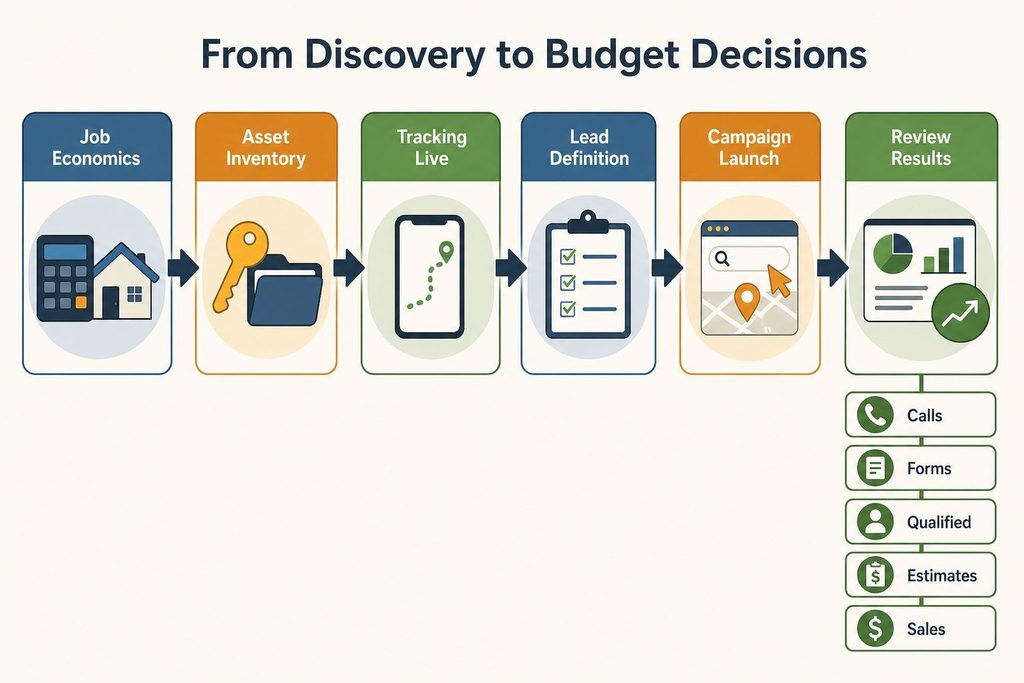
The first weeks of an engagement should follow a specific, checkable sequence, and a contractor is entitled to see that sequence in writing before work starts. Discovery comes first: the agency should ask about job economics, margin thresholds, and current estimator capacity, not just brand preferences.
Access and asset inventory follows, confirming who owns the website, ad accounts, and phone numbers now and after the contract ends. Tracking configuration comes next, and it has to happen before any campaign spend increases, not after.
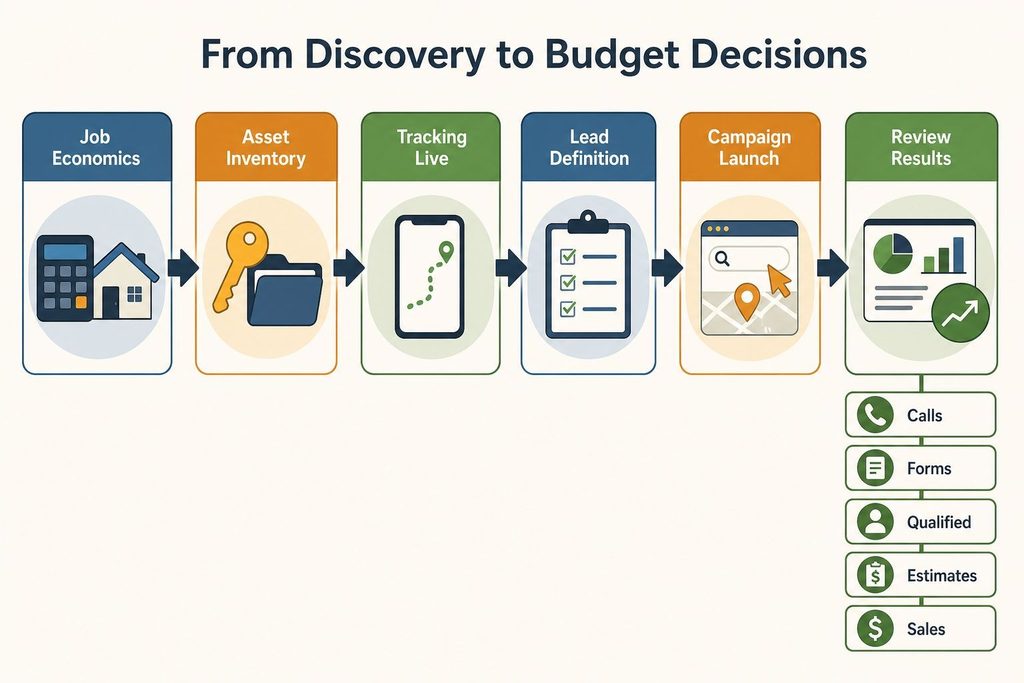
Call tracking and conversion tracking need to be live and confirmed working, with the contractor able to see raw call and form data, not just a summarized count.
Lead-definition confirmation follows: the agency restates the contractor’s qualification criteria back in writing, so there is a documented standard both sides are working against. Only then should campaign or local-visibility work begin, followed by a recurring review cycle on a fixed schedule.
That recurring report needs a specific shape:
- calls
- forms
- qualified opportunities
- estimates booked
- outcomes where the data exists
- lead source
- service area breakdown
- the reasons any lead was excluded as unqualified.
| Identifying which sources are actually producing closed deals | rather than which sources produce the most inquiries |
|---|---|
| is what lets a contractor reallocate budget toward what is working | rather than what looks active. |
How Can Pricing And Contract Terms Protect Return On Investment?
Every proposal bundles several different kinds of cost into one number, and separating them is the only way to know what is actually being paid for. Management fees cover the agency’s labor. Media spend covers the ad platforms themselves.
Setup work covers the one-time cost of building tracking, landing pages, or a new site. Production costs, for video or photography, are often optional and should be priced as such, not folded silently into a retainer.
Each of those costs should connect back to the lead definition and capacity limits established earlier. A media budget sized for a business that can only handle fifteen estimates a month is money aimed at a bottleneck rather than an opportunity.
Before signing anything, get written answers on a short list of terms: ownership of the website, ad accounts, analytics, phone numbers, and creative assets; who retains access to raw data during and after the contract; cancellation terms and required notice; reporting cadence; and exactly what changes in the plan if qualified-lead quality drops mid-contract.
If a discussion of advertising platform policy or local advertising rules comes up, treat it strictly as a question to raise with the agency and escalate if needed, not a detail to resolve independently.
What Should A Contractor Ask An Agency Today?
The single next action is not another sales call. It is a written request sent to every finalist still under consideration, worded identically for each so the answers can be compared side by side rather than absorbed one pitch at a time. That written request should ask for evidence, not adjectives, and it should ask for it before any contract terms are finalized.
Whatever comes back, read it against the job definitions already written down, the capacity already known, and the reporting already specified. The answer that matters is whether the agency can be held to those terms after the contract starts, not how well it can talk before one is signed.
Send this to each agency still in consideration:
Please show how your process defines and tracks a qualified lead for our trade and service area. Include comparable evidence, reporting access, asset ownership, fees, and exit terms. Show which outcomes are measured after an estimate is booked and how results would be reviewed.ned job.
The owner found out only when a bookkeeper asked why marketing spend had doubled while sold work had not moved.
That gap between activity and outcome is not a one-off failure. It is the default result of hiring a marketing partner that measures the wrong thing, because the wrong thing is easier to report.
This happens because standard advertising agencies are built to optimize the metrics that generalize across industries: traffic, click-through rate, cost per lead. None of that maps cleanly to a construction business, where a “lead” might be a homeowner three states outside the service area, a job too small to cover overhead, or a tire-kicker who never intended to sign a contract.
Why Do Standard Ad Agencies Miss What Makes Contractor Marketing Work?
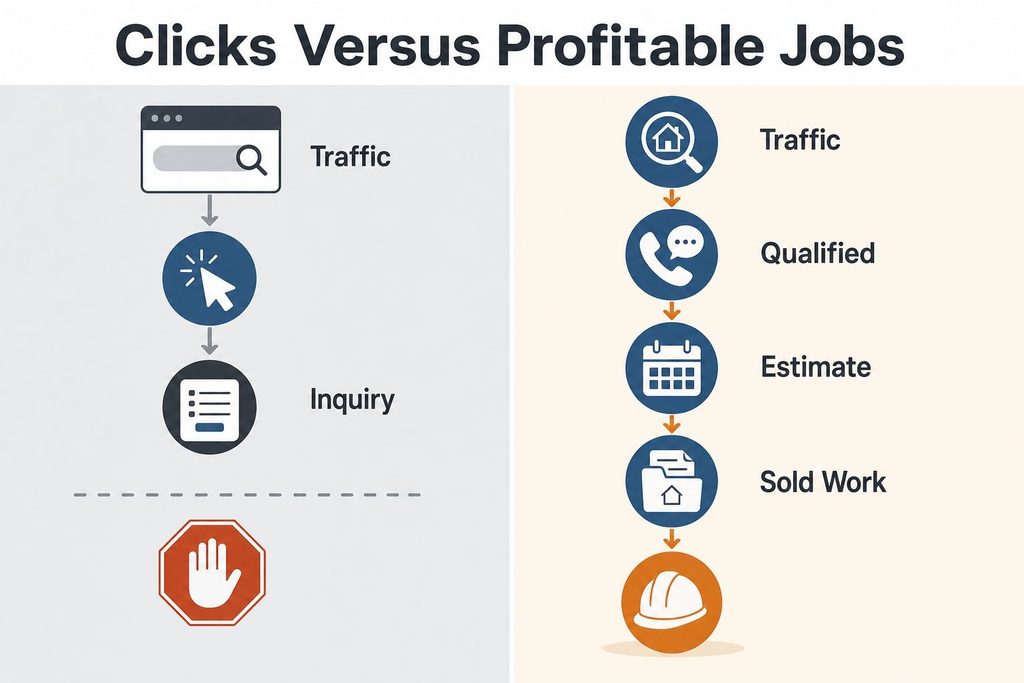
The failure is structural, not accidental. A standard agency reports success the moment a form fills or a phone rings, because that is where its accountability ends.
It has no visibility into what happens after the call, whether the estimator drove forty minutes to a house outside the service radius, or whether the job size fell below the minimum needed to be worth booking. The desired result for a contractor is not more inquiries. It is a predictable flow of qualified opportunities that convert into profitable, schedulable work.
That distinction changes what should be measured, and by whom.
| Comparison Point | Specialized Contractor Marketing Agency | Standard Advertising Agency |
|---|---|---|
| Profitable-job definition | Builds targeting around job value, trade capacity, and margin thresholds set by the contractor | Optimizes for lead volume or cost per click, independent of job profitability |
| Service-area and local intent | Structures campaigns around drivable radius, permit jurisdictions, and neighborhood-level demand | Runs geographic targeting as a setting, not a strategic input tied to crew logistics |
| Reviews and reputation | Treats Google Business Profile activity and review generation as core lead-quality signals | Treats reviews as a reputation-management add-on, separate from lead campaigns |
| Estimate handoff | Tracks whether inquiries convert to booked estimates and flags mismatched leads | Stops measuring once the call or form fill happens |
| Outcome reporting | Reports calls, qualified opportunities, estimates booked, and closed-deal source where data allows | Reports impressions, clicks, and cost per lead as the endpoint |
The pattern across every row is the same. One side of the table treats the estimate and the sale as the object of the campaign. The other treats the click as the object, and everything downstream as someone else’s problem.
A contractor comparing proposals should ask, line by line, which of those two postures each finalist actually operates from, not which one it claims in a pitch deck.
What Does the Wrong Agency Actually Cost a General Contractor?
The cost is not just the retainer. Wasted media and management fees are the visible layer, but the deeper cost sits in estimator time. Every unqualified inquiry that reaches an estimator, whether by phone, form, or chat, consumes hours that could have gone to a viable bid.
A crew’s or estimator’s capacity is finite. A stream of leads outside the service area, below minimum job value, or outside the trade’s actual scope consumes that capacity without producing revenue, and the drain rarely shows up until someone checks the numbers against sold work.
There is a useful distinction hiding inside “leads” that most reporting collapses into one number. Traffic, inquiries, qualified leads, booked estimates, sold jobs, and profitable work are six different stages, and a loss at any stage looks identical in a summary report that only counts the first two.
Missed local visibility compounds the problem in a way that rarely shows up in a monthly report. If review generation and Google Business Profile activity are neglected while ad spend runs, the contractor loses ground competitors are actively closing.
Reputation risk follows the same path: a generic agency running ads with no connection to actual review management can amplify visibility for a listing that is thin or outdated, sending more scrutiny toward a weaker storefront.
How Should A Contractor Define The Work Worth Marketing Before Comparing Agencies?
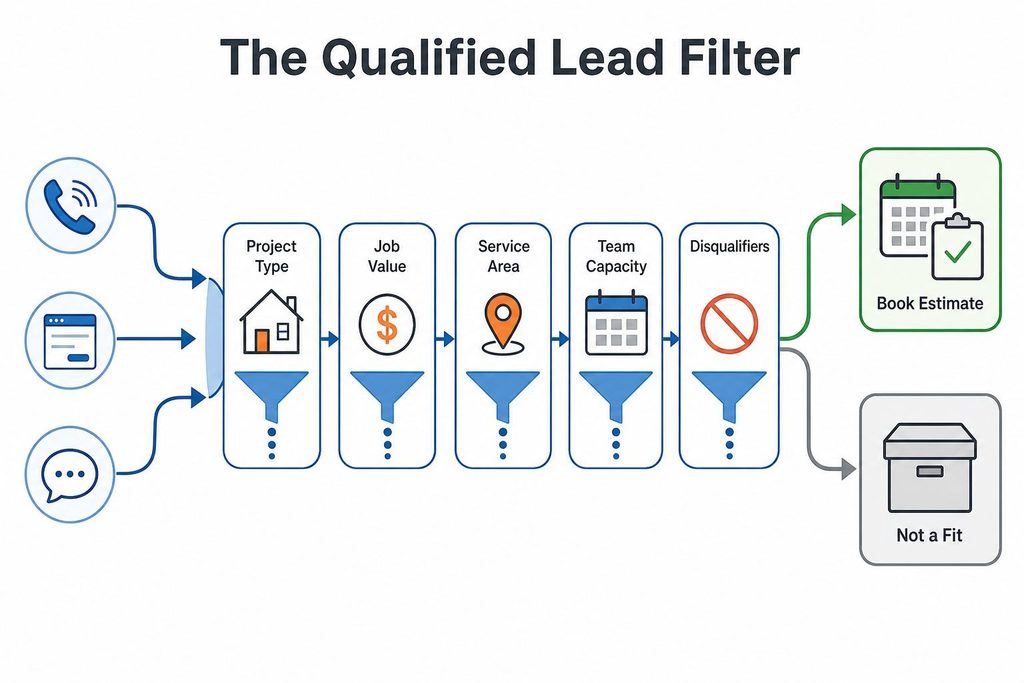
Before any proposal gets evaluated, the contractor has to write down what a qualified lead actually is, in terms specific to the business, not the industry. That document does not need to be long, but it needs to exist before a single agency call happens.
- Ideal trade and project type the business is actually staffed and equipped to deliver profitably right now.
- Minimum job value or margin threshold below which an estimate is not worth booking.
- Service areas, defined by drive time or jurisdiction, not a radius drawn for convenience.
- Capacity and schedule limits, including how many estimates the team can realistically handle per week.
- Disqualifiers, such as job types the business no longer takes or areas it has stopped serving.
- A working definition of a qualified estimate, stated in plain terms an agency can be held to.
Bid Work Versus Negotiated Work
A contractor bidding competitively against other firms needs volume and speed in the qualification process, since many bids will not convert regardless of lead quality.
A contractor doing negotiated, relationship-driven work needs fewer, better-vetted leads, and a very different tolerance for cost per qualified opportunity. Treating both under one lead definition guarantees the wrong metric gets optimized for one of the two models.
How Trade, Job Type, and Area Change Qualification
A solar installer, a roofer, and a flooring contractor do not share a sales cycle, a service radius, or a seasonal demand curve, and none of them should be evaluated against a single generic qualification bar.
Solar sales often involve financing conversations and longer decision windows. Roofing work is frequently storm-driven and time-compressed. Flooring projects tend to be scheduled around other renovation work. Qualification criteria need to reflect that, not borrow a template built for a different trade entirely.
Which Contractor Marketing Capabilities Should An Agency Connect To Qualified Leads?
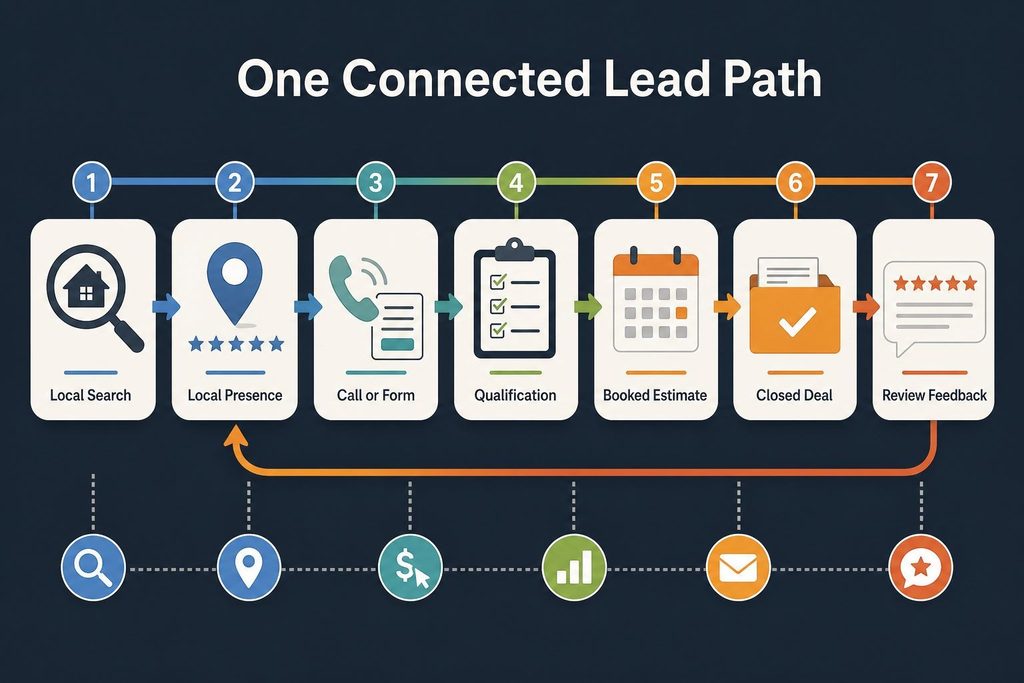
A lead path has stages, and an agency worth paying should be able to describe every one of them without switching topics. It starts with local search or neighborhood awareness, someone searching a service term or noticing recent work nearby, moving to a credible local presence: a Google Business Profile with real reviews, accurate listings across directories, and evidence of work actually done in that neighborhood.
From there it becomes a call or form, then a qualification step against the contractor’s own criteria, then a booked estimate, then a sale, and finally a review of which source actually produced that closed deal.
The failure mode is treating each of those as a separate service line item rather than one connected sequence. Local SEO without accurate directory listings undermines trust at the exact moment a prospect is deciding whether to call.
Paid search without call tracking and conversion tracking produces spend with no accountability for what happened after the click. Reviews without neighborhood-specific project relevance read as generic rather than credible to someone checking whether a contractor has actually worked on their type of house.
Evaluating whether a firm operates this way, rather than selling channels individually, is the core test of a contractor marketing agency. A 2026 contractor-focused marketing page from Blue Corona lists services for contractors including SEO, local SEO, website design, PPC, social media, email marketing, chat, analytics and tracking, video, and branding.
A separate marketing agency describes an integrated system combining SEO, PPC, web design, automation, and customer support. Both describe broad stacks. Neither description is proof that the stack functions as one connected lead path for a specific contractor’s trade and service area. That has to be tested, not assumed from a services list.
What Proof Should An Agency Provide Before A Contract Is Signed?
Every agency will describe itself as data-driven and results-focused. None of that is verifiable from a sales conversation. What is verifiable is a specific, inspectable set of materials the agency should produce before a signature, not after.
Score what is demonstrated, not what is promised. A proposal that repeats the contractor’s own lead definition back with a plan attached is worth more than one built around generic benchmarks. Results depend on the contractor’s market, capacity, and follow-up discipline, so any figure the agency offers should be checked against the contractor’s own historical records, not accepted on faith.
- Relevant case studies from the same trade, a comparable service area, and a comparable job size, not a portfolio of unrelated industries.
- Testimonials or direct references the contractor can actually call, from businesses of similar size and scope.
- A written proposal tied to the stated lead definition, not a generic package of deliverables.
- Service-area strategy examples showing how targeting respects drive time, capacity, and jurisdiction.
- Access to call and form tracking as a condition of the engagement, not a feature unlocked later.
- Reporting that spans inquiry through outcome, including estimates booked and sales where data allows.
- Clear ownership terms for the website, ad accounts, and tracking assets built during the engagement.
- A defined exit path, including what happens to those assets if the contract ends.
Evidence Of Contractor Expertise
A firm that has actually worked with trades should be able to speak fluently about seasonal demand swings, permit-driven timelines, and the difference between a bid market and a negotiated one. Vague answers about “driving growth for home service businesses” without specifics are a signal, not a formality.
What a Real Sample Report Looks Like
Ask to see an actual sample report, not a mockup built for the pitch. A firm with real measurement discipline can show a report with calls, qualified opportunities, and booked estimates from an existing client, with names redacted. A firm without it will offer a template full of placeholder numbers, and that gap is usually visible within the first two questions.
What Should Onboarding And Reporting Reveal In The First Review Cycle?
The first weeks of an engagement should follow a specific, checkable sequence, and a contractor is entitled to see that sequence in writing before work starts. Discovery comes first: the agency should ask about job economics, margin thresholds, and current estimator capacity, not just brand preferences.
Access and asset inventory follows, confirming who owns the website, ad accounts, and phone numbers now and after the contract ends. Tracking configuration comes next, and it has to happen before any campaign spend increases, not after.
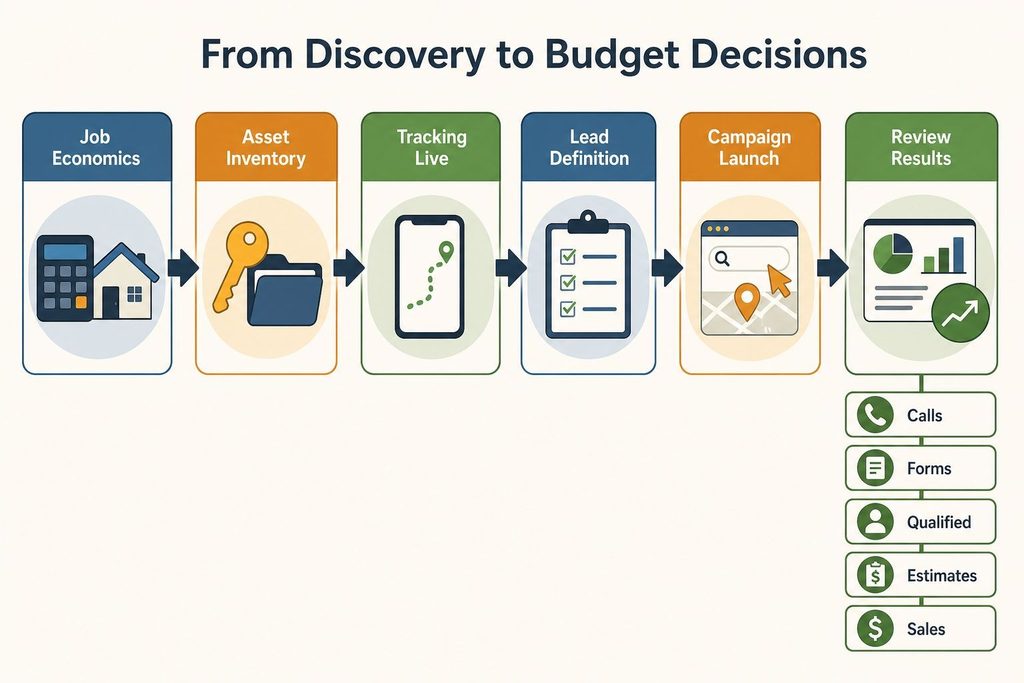
Call tracking and conversion tracking need to be live and confirmed working, with the contractor able to see raw call and form data, not just a summarized count.
Lead-definition confirmation follows: the agency restates the contractor’s qualification criteria back in writing, so there is a documented standard both sides are working against. Only then should campaign or local-visibility work begin, followed by a recurring review cycle on a fixed schedule.
That recurring report needs a specific shape:
- calls
- forms
- qualified opportunities
- estimates booked
- outcomes where the data exists
- lead source
- service area breakdown
- the reasons any lead was excluded as unqualified.
| Identifying which sources are actually producing closed deals | rather than which sources produce the most inquiries |
|---|---|
| is what lets a contractor reallocate budget toward what is working | rather than what looks active. |
How Can Pricing And Contract Terms Protect Return On Investment?
Every proposal bundles several different kinds of cost into one number, and separating them is the only way to know what is actually being paid for. Management fees cover the agency’s labor. Media spend covers the ad platforms themselves.
Setup work covers the one-time cost of building tracking, landing pages, or a new site. Production costs, for video or photography, are often optional and should be priced as such, not folded silently into a retainer.
Each of those costs should connect back to the lead definition and capacity limits established earlier. A media budget sized for a business that can only handle fifteen estimates a month is money aimed at a bottleneck rather than an opportunity.
Before signing anything, get written answers on a short list of terms: ownership of the website, ad accounts, analytics, phone numbers, and creative assets; who retains access to raw data during and after the contract; cancellation terms and required notice; reporting cadence; and exactly what changes in the plan if qualified-lead quality drops mid-contract.
If a discussion of advertising platform policy or local advertising rules comes up, treat it strictly as a question to raise with the agency and escalate if needed, not a detail to resolve independently.
What Should A Contractor Ask An Agency Today?
The single next action is not another sales call. It is a written request sent to every finalist still under consideration, worded identically for each so the answers can be compared side by side rather than absorbed one pitch at a time. That written request should ask for evidence, not adjectives, and it should ask for it before any contract terms are finalized.
Whatever comes back, read it against the job definitions already written down, the capacity already known, and the reporting already specified. The answer that matters is whether the agency can be held to those terms after the contract starts, not how well it can talk before one is signed.
Send this to each agency still in consideration:
Please show how your process defines and tracks a qualified lead for our trade and service area. Include comparable evidence, reporting access, asset ownership, fees, and exit terms. Show which outcomes are measured after an estimate is booked and how results would be reviewed.
A regional remodeling company spent four months paying an advertising agency to run search ads and social posts. The reports looked healthy: impressions climbing, clicks up, cost per click trending down. Nobody on the agency side, and nobody on the contractor side, could say how many of those clicks turned into a booked estimate, let alone a signed job.
The owner found out only when a bookkeeper asked why marketing spend had doubled while sold work had not moved.
That gap between activity and outcome is not a one-off failure. It is the default result of hiring a marketing partner that measures the wrong thing, because the wrong thing is easier to report.
This happens because standard advertising agencies are built to optimize the metrics that generalize across industries: traffic, click-through rate, cost per lead. None of that maps cleanly to a construction business, where a “lead” might be a homeowner three states outside the service area, a job too small to cover overhead, or a tire-kicker who never intended to sign a contract.
Why Do Standard Ad Agencies Miss What Makes Contractor Marketing Work?
The failure is structural, not accidental. A standard agency reports success the moment a form fills or a phone rings, because that is where its accountability ends.
It has no visibility into what happens after the call, whether the estimator drove forty minutes to a house outside the service radius, or whether the job size fell below the minimum needed to be worth booking. The desired result for a contractor is not more inquiries. It is a predictable flow of qualified opportunities that convert into profitable, schedulable work.
That distinction changes what should be measured, and by whom.
| Comparison Point | Specialized Contractor Marketing Agency | Standard Advertising Agency |
|---|---|---|
| Profitable-job definition | Builds targeting around job value, trade capacity, and margin thresholds set by the contractor | Optimizes for lead volume or cost per click, independent of job profitability |
| Service-area and local intent | Structures campaigns around drivable radius, permit jurisdictions, and neighborhood-level demand | Runs geographic targeting as a setting, not a strategic input tied to crew logistics |
| Reviews and reputation | Treats Google Business Profile activity and review generation as core lead-quality signals | Treats reviews as a reputation-management add-on, separate from lead campaigns |
| Estimate handoff | Tracks whether inquiries convert to booked estimates and flags mismatched leads | Stops measuring once the call or form fill happens |
| Outcome reporting | Reports calls, qualified opportunities, estimates booked, and closed-deal source where data allows | Reports impressions, clicks, and cost per lead as the endpoint |
The pattern across every row is the same. One side of the table treats the estimate and the sale as the object of the campaign. The other treats the click as the object, and everything downstream as someone else’s problem.
A contractor comparing proposals should ask, line by line, which of those two postures each finalist actually operates from, not which one it claims in a pitch deck.
What Does the Wrong Agency Actually Cost a General Contractor?
The cost is not just the retainer. Wasted media and management fees are the visible layer, but the deeper cost sits in estimator time. Every unqualified inquiry that reaches an estimator, whether by phone, form, or chat, consumes hours that could have gone to a viable bid.
A crew’s or estimator’s capacity is finite. A stream of leads outside the service area, below minimum job value, or outside the trade’s actual scope consumes that capacity without producing revenue, and the drain rarely shows up until someone checks the numbers against sold work.
There is a useful distinction hiding inside “leads” that most reporting collapses into one number. Traffic, inquiries, qualified leads, booked estimates, sold jobs, and profitable work are six different stages, and a loss at any stage looks identical in a summary report that only counts the first two.
Missed local visibility compounds the problem in a way that rarely shows up in a monthly report. If review generation and Google Business Profile activity are neglected while ad spend runs, the contractor loses ground competitors are actively closing.
Reputation risk follows the same path: a generic agency running ads with no connection to actual review management can amplify visibility for a listing that is thin or outdated, sending more scrutiny toward a weaker storefront.
How Should A Contractor Define The Work Worth Marketing Before Comparing Agencies?
Before any proposal gets evaluated, the contractor has to write down what a qualified lead actually is, in terms specific to the business, not the industry. That document does not need to be long, but it needs to exist before a single agency call happens.
- Ideal trade and project type the business is actually staffed and equipped to deliver profitably right now.
- Minimum job value or margin threshold below which an estimate is not worth booking.
- Service areas, defined by drive time or jurisdiction, not a radius drawn for convenience.
- Capacity and schedule limits, including how many estimates the team can realistically handle per week.
- Disqualifiers, such as job types the business no longer takes or areas it has stopped serving.
- A working definition of a qualified estimate, stated in plain terms an agency can be held to.
Bid Work Versus Negotiated Work
A contractor bidding competitively against other firms needs volume and speed in the qualification process, since many bids will not convert regardless of lead quality.
A contractor doing negotiated, relationship-driven work needs fewer, better-vetted leads, and a very different tolerance for cost per qualified opportunity. Treating both under one lead definition guarantees the wrong metric gets optimized for one of the two models.
How Trade, Job Type, and Area Change Qualification
A solar installer, a roofer, and a flooring contractor do not share a sales cycle, a service radius, or a seasonal demand curve, and none of them should be evaluated against a single generic qualification bar.
Solar sales often involve financing conversations and longer decision windows. Roofing work is frequently storm-driven and time-compressed. Flooring projects tend to be scheduled around other renovation work. Qualification criteria need to reflect that, not borrow a template built for a different trade entirely.
Which Contractor Marketing Capabilities Should An Agency Connect To Qualified Leads?
A lead path has stages, and an agency worth paying should be able to describe every one of them without switching topics. It starts with local search or neighborhood awareness, someone searching a service term or noticing recent work nearby, moving to a credible local presence: a Google Business Profile with real reviews, accurate listings across directories, and evidence of work actually done in that neighborhood.
From there it becomes a call or form, then a qualification step against the contractor’s own criteria, then a booked estimate, then a sale, and finally a review of which source actually produced that closed deal.
The failure mode is treating each of those as a separate service line item rather than one connected sequence. Local SEO without accurate directory listings undermines trust at the exact moment a prospect is deciding whether to call.
Paid search without call tracking and conversion tracking produces spend with no accountability for what happened after the click. Reviews without neighborhood-specific project relevance read as generic rather than credible to someone checking whether a contractor has actually worked on their type of house.
Evaluating whether a firm operates this way, rather than selling channels individually, is the core test of a contractor marketing agency. A 2026 contractor-focused marketing page from Blue Corona lists services for contractors including SEO, local SEO, website design, PPC, social media, email marketing, chat, analytics and tracking, video, and branding.
A separate marketing agency describes an integrated system combining SEO, PPC, web design, automation, and customer support. Both describe broad stacks. Neither description is proof that the stack functions as one connected lead path for a specific contractor’s trade and service area. That has to be tested, not assumed from a services list.
What Proof Should An Agency Provide Before A Contract Is Signed?
Every agency will describe itself as data-driven and results-focused. None of that is verifiable from a sales conversation. What is verifiable is a specific, inspectable set of materials the agency should produce before a signature, not after.
Score what is demonstrated, not what is promised. A proposal that repeats the contractor’s own lead definition back with a plan attached is worth more than one built around generic benchmarks. Results depend on the contractor’s market, capacity, and follow-up discipline, so any figure the agency offers should be checked against the contractor’s own historical records, not accepted on faith.
- Relevant case studies from the same trade, a comparable service area, and a comparable job size, not a portfolio of unrelated industries.
- Testimonials or direct references the contractor can actually call, from businesses of similar size and scope.
- A written proposal tied to the stated lead definition, not a generic package of deliverables.
- Service-area strategy examples showing how targeting respects drive time, capacity, and jurisdiction.
- Access to call and form tracking as a condition of the engagement, not a feature unlocked later.
- Reporting that spans inquiry through outcome, including estimates booked and sales where data allows.
- Clear ownership terms for the website, ad accounts, and tracking assets built during the engagement.
- A defined exit path, including what happens to those assets if the contract ends.
Evidence Of Contractor Expertise
A firm that has actually worked with trades should be able to speak fluently about seasonal demand swings, permit-driven timelines, and the difference between a bid market and a negotiated one. Vague answers about “driving growth for home service businesses” without specifics are a signal, not a formality.
What a Real Sample Report Looks Like
Ask to see an actual sample report, not a mockup built for the pitch. A firm with real measurement discipline can show a report with calls, qualified opportunities, and booked estimates from an existing client, with names redacted. A firm without it will offer a template full of placeholder numbers, and that gap is usually visible within the first two questions.
What Should Onboarding And Reporting Reveal In The First Review Cycle?
The first weeks of an engagement should follow a specific, checkable sequence, and a contractor is entitled to see that sequence in writing before work starts. Discovery comes first: the agency should ask about job economics, margin thresholds, and current estimator capacity, not just brand preferences.
Access and asset inventory follows, confirming who owns the website, ad accounts, and phone numbers now and after the contract ends. Tracking configuration comes next, and it has to happen before any campaign spend increases, not after.
Call tracking and conversion tracking need to be live and confirmed working, with the contractor able to see raw call and form data, not just a summarized count.
Lead-definition confirmation follows: the agency restates the contractor’s qualification criteria back in writing, so there is a documented standard both sides are working against. Only then should campaign or local-visibility work begin, followed by a recurring review cycle on a fixed schedule.
That recurring report needs a specific shape:
- calls
- forms
- qualified opportunities
- estimates booked
- outcomes where the data exists
- lead source
- service area breakdown
- the reasons any lead was excluded as unqualified.
| Identifying which sources are actually producing closed deals | rather than which sources produce the most inquiries |
|---|---|
| is what lets a contractor reallocate budget toward what is working | rather than what looks active. |
How Can Pricing And Contract Terms Protect Return On Investment?
Every proposal bundles several different kinds of cost into one number, and separating them is the only way to know what is actually being paid for. Management fees cover the agency’s labor. Media spend covers the ad platforms themselves.
Setup work covers the one-time cost of building tracking, landing pages, or a new site. Production costs, for video or photography, are often optional and should be priced as such, not folded silently into a retainer.
Each of those costs should connect back to the lead definition and capacity limits established earlier. A media budget sized for a business that can only handle fifteen estimates a month is money aimed at a bottleneck rather than an opportunity.
Before signing anything, get written answers on a short list of terms: ownership of the website, ad accounts, analytics, phone numbers, and creative assets; who retains access to raw data during and after the contract; cancellation terms and required notice; reporting cadence; and exactly what changes in the plan if qualified-lead quality drops mid-contract.
If a discussion of advertising platform policy or local advertising rules comes up, treat it strictly as a question to raise with the agency and escalate if needed, not a detail to resolve independently.
What Should A Contractor Ask An Agency Today?
The single next action is not another sales call. It is a written request sent to every finalist still under consideration, worded identically for each so the answers can be compared side by side rather than absorbed one pitch at a time. That written request should ask for evidence, not adjectives, and it should ask for it before any contract terms are finalized.
Whatever comes back, read it against the job definitions already written down, the capacity already known, and the reporting already specified. The answer that matters is whether the agency can be held to those terms after the contract starts, not how well it can talk before one is signed.
Send this to each agency still in consideration:
Please show how your process defines and tracks a qualified lead for our trade and service area. Include comparable evidence, reporting access, asset ownership, fees, and exit terms. Show which outcomes are measured after an estimate is booked and how results would be reviewed.