

How to Own the Google Map Pack in Your Local Construction Service Radius
Ranking higher in the map pack does not, by itself, produce a single booked job.
That statement runs against most of what gets sold as local search strategy, but it holds up under scrutiny: visibility and demand are two different systems, measured differently, and failing for different reasons.
A crew can climb the map results for its core categories and still watch estimate requests stay flat, or worse, come in from addresses too far away to serve profitably. That gap, between where a business appears and what its office actually converts, is where most local search effort goes to waste.
Closing it requires treating Google Maps placement as one input among several, not the finish line.
Diagnose the Gap Between Map Visibility and Estimate Flow
The outcome worth chasing is not a position in the map pack. It is a predictable count of qualified estimate requests from addresses inside a service radius the business can actually staff and price competitively. Ranking is a proxy for that outcome, not a substitute for it, and treating the two as interchangeable is where the diagnosis usually goes wrong.
A business can appear in the map pack for its main category and still convert poorly if three other conditions are weak.
- Response time to inquiries matters: a call or form submission answered six hours later competes against contractors who called back in twenty minutes.
- Service capacity matters too: showing up for jobs the crew cannot schedule for weeks just trains prospects to book elsewhere.
- And the profile and website have to carry enough local proof, real project detail, honest service-area language, consistent contact information, that a prospect trusts the business enough to request a number.
Leads from search come from matching discoverability with credible local proof and a functioning response path, not from rank position alone.
Where estimate flow is inconsistent, the fix is rarely “rank higher.” It is usually a mismatch somewhere in that chain: visible but unresponsive, visible but unconvincing, or visible for the wrong geography entirely.
Separate Map Visibility From Organic Traffic and Booked Jobs
Every channel in a local lead system measures something different, and conflating them is how a business ends up optimizing the wrong thing for months. Map pack presence, website rankings, phone calls, and booked jobs each answer a distinct question, and each requires a distinct measurement approach.
| Signal | What It Measures | Operational Meaning |
|---|---|---|
| Map pack / Maps visibility | Whether the business appears for a nearby search | Discoverability only; no confirmation of intent or fit |
| Organic website rankings | Whether a service page surfaces for a search term | Interest signal; still no confirmation of contact |
| Phone calls / form leads | Whether a visible prospect took action | First real signal of demand; needs staff follow-up to matter |
| Booked jobs | Whether a lead converted to scheduled, paid work | The only signal that reflects revenue and capacity use |
Reading this top to bottom shows the risk of stopping at row one. A contractor can improve map visibility and see the number climb on a ranking tool while calls stay level, because visibility changes exposure, not conversion.
The strongest lead source is not a single channel at all. It is the service-and-location demand the business can actually fulfill, captured consistently from the moment someone searches through to the estimate being written and the job being scheduled. Everything upstream of that final step is diagnostic, not proof of results.
Complete the Google Business Profile for Map Pack Ranking
Google Business Profile, still called Google My Business in a fair amount of older material and in staff habit, is the one asset in this system a contractor controls directly. Unlike backlinks or algorithm behavior, every field on the profile can be checked, corrected, and verified in a single sitting, which makes it the highest-leverage starting point for map pack optimization.
What the Profile Itself Has to Get Right
The baseline work here is unglamorous but non-negotiable.
A local SEO guide describes a fully completed profile, meaning:
- a verified listing
- accurate name-address-phone data
- current services
- correct hours
- relevant attributes
- real photos
as the floor for any local optimization effort, not an advanced tactic.
- Verification status: confirm the listing is verified under the current owner, not an old or duplicate profile still active from a previous setup
- Primary category accuracy: the primary category should match the main revenue service, with secondary categories added only where the work is genuinely offered
- Service-area configuration: for businesses without a public storefront, service areas should be set to reflect real, staffable territory rather than an aspirational radius
- NAP consistency: name, address, and phone number should match exactly across the profile, the website, and any other place the business is listed
- Hours, services, and attributes: kept current, especially after seasonal changes or after adding a new service line
What Has to Prove the Business Actually Operates There
Accuracy alone does not build trust with a searcher comparing three contractors at once. Photos of completed work, ideally tied to specific jobs rather than stock imagery, do more to establish credibility than another paragraph of service description. Review responses, written individually rather than copy-pasted, signal that the business is actively managed.
None of this should extend to inventing a second office to expand map reach, listing a service area the crew cannot reasonably reach, or paying for reviews. Each of those creates a policy risk that can cost the listing entirely, trading a short-term visibility bump for a suspended profile with no visibility at all.
Match Service Areas to Real Operating Capacity
Before touching a website or a profile setting, the more useful exercise is deciding which service-and-location combinations deserve investment at all. That decision runs on operating economics, not ambition.
- Start with travel and job economics: a location forty minutes away with thin margins on the job type offered there is not worth the same effort as one fifteen minutes out with steady demand. Next, confirm the service is genuinely offered at that location, not listed defensively because a competitor covers it. A profile or page claiming a service the crew rarely performs there creates a mismatch the first time a prospect calls expecting it.
- From there, compare current map visibility for each combination the business has confirmed it can serve. Some pairings may already show reasonable presence with room to improve; others may show almost none, which changes where effort is best spent first.
- The final step is narrowing to a manageable set, typically the combinations with the clearest capacity fit and the weakest current visibility, rather than trying to improve every service-area pairing simultaneously.
A broad radius claim looks appealing on a profile, but it is not the same thing as evidence the business can serve that ground. That evidence has to be concrete:
- Real jobs completed there, not just claimed
- A crew that has actually traveled that distance on a regular job
- Permits or inspections handled in that jurisdiction
Reviewers, human and algorithmic, respond to the difference. No claim about a specific city’s map pack behavior, permitting environment, seasonal demand pattern, or local landmark relevance can be responsibly made here, since no particular location has been supplied for this analysis. That guidance has to come from data specific to wherever the business actually operates.
Build Service Pages That Demonstrate Local Proof
Adding more location pages to a website does not automatically add more relevance. A guide on Google Business Profile and local optimization does note that service-area businesses without a public storefront often benefit from adding service-area information and location-specific landing pages, but the value comes from what those pages contain, not from their existence.
What a Service Page Actually Needs
A page built around “roofing services” or “concrete work” earns its place when it describes the scope of that work in specific terms: materials used, typical project size, constraints the crew regularly navigates (permit timelines, HOA approval steps, seasonal scheduling limits), and the process a client goes through from estimate to completion. A page that repeats generic industry language with the city name swapped in is easy for both readers and search systems to identify as thin.
What Makes a Location Page Worth Publishing
A location page earns a separate URL only if there is something genuinely different to say about that location: distinct permitting requirements, a documented project history there, travel logistics that affect scheduling. Where none of that exists, folding the location into a broader service-area description on one page is more honest, and often performs better, than a duplicate page with the town name changed.
Contractors weighing how much of this to build in-house versus assign out often find it useful to review a structured breakdown of contractor local seo before committing a crew’s limited web-editing time to pages that will not hold up under scrutiny. The pages that hold up are the ones a competitor cannot simply copy, because the proof inside them is specific to the work actually done.
Earn Reviews and Maintain Consistent Business Signals
Reviews and consistent contact data function as trust infrastructure, and both degrade if nobody owns the process. The remediation sequence here is straightforward, but skipping a step tends to show up later as a stalled review count or a profile that diverges from the website.
- Requests should go out shortly after work is completed, while the experience is still fresh, using a direct link and a short, neutral message that does not pressure the client toward a specific rating. A request sent three weeks later, buried in an invoice email, gets ignored far more often than one sent the day after final walkthrough.
- Every review, positive or critical, deserves a specific, professional response rather than a templated one. A critical review answered calmly and factually often reads better to a prospective client than five generic five-star reviews with no replies at all.
- Separately, and on a recurring basis, someone should check that the business name, address, and phone number are identical across the website, the Google Business Profile, and any other place the business is listed. A phone number that changed after a system migration but never got updated on an old directory listing creates exactly the kind of inconsistency that undermines trust signals without anyone catching it until a client mentions it.
None of this should be read as a guarantee that review volume or listing consistency moves ranking by a fixed amount. Fabricated reviews or invented consistency, a fake second location to pad citations, for instance, create reputational and policy exposure that outweighs any short-term gain.
Measure Local Leads and Act Within the First 48 Hours
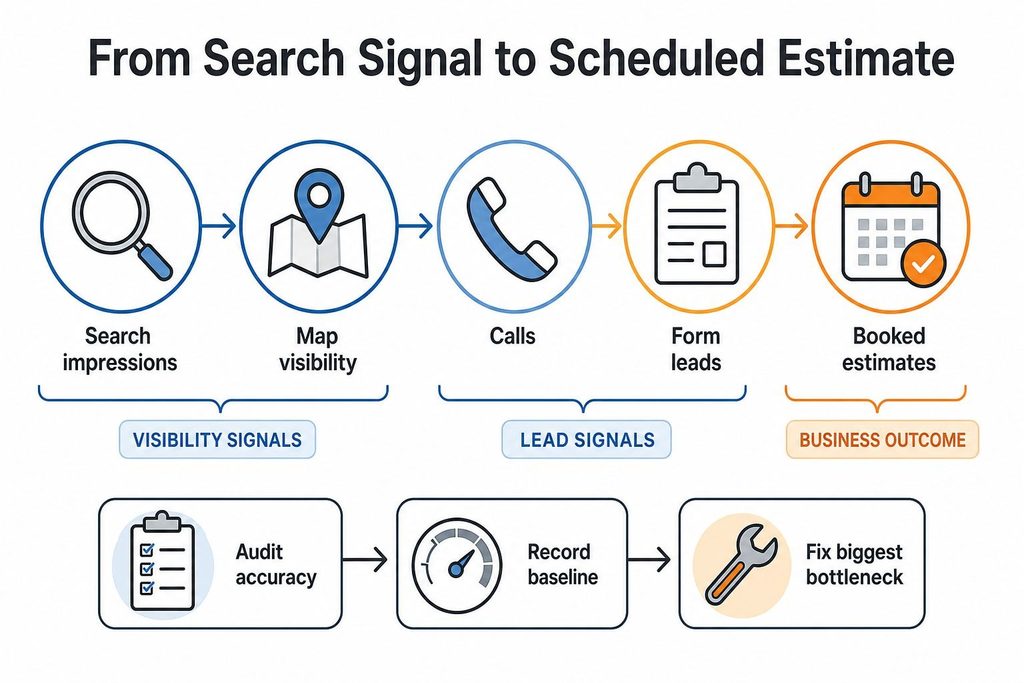
A workable measurement setup connects five things: Google Search Console impressions and organic traffic for service pages, observed map pack visibility for priority searches, tracked phone calls, form-lead volume, and the conversion rate from lead to booked estimate. Without all five in view at once, it is easy to mistake a rise in impressions for a rise in revenue.
The 80/20 question, asked often by teams with limited time, has a specific answer here. It is not a ranking formula. It means prioritizing the small set of verified fixes that are most likely to remove ambiguity from the system, ahead of anything speculative:
- profile accuracy
- local proof on service pages
- a working review request habit
- fast lead response
- functioning call and form tracking
Pricing questions deserve the same discipline. Scope should be assessed against the business’s current baseline, its real capacity to take on new work, who owns ongoing profile and content upkeep, and what deliverables can actually be measured, rather than against a number promised in advance.
The next two days matter more than the next two months, because acting now on the right first move prevents weeks of misdirected effort:
- Audit profile and contact accuracy first, because every later step, service-area decisions, page content, review requests, depends on the underlying data being correct.
- Record priority service-location searches and current lead baseline second, since this establishes what “improvement” will actually mean before any change is made.
- Assign the single largest bottleneck third, whether that is slow response time, thin service pages, or missing call tracking, so the next two weeks of effort go toward the constraint most likely holding back booked jobs.
Whoever owns this today should start with the profile audit before end of day, not because it is the most complex piece, but because every decision downstream of it depends on the accuracy of what’s already there.