

Building Long-Term Organic Search Growth for Commercial and Residential Contractors
A general contractor spent eleven months paying a developer to rebuild a company website, added a slider of finished kitchens to the homepage, and waited for the phone to ring. It did not ring, not from that site anyway. The pages had no service-specific content, no location signals, and no path connecting a homeowner’s search for a kitchen remodel to a page built to answer it.
The work was real. The visibility was not.
That mistake is common because it looks like progress. A new site feels like marketing has been handled, when in fact the harder, less visible work of matching pages to search intent was never started.
What SEO Means for General Contractors Seeking Commercial and Residential Projects
Search engine optimization, for a contractor, is the system that connects what a prospective client is searching for to a specific page built to answer that search. It is not the website itself. It is the layer of relevance sitting underneath it: the keywords a page targets, the location it signals, and the proof of past work attached to it.
A site can be well designed and still invisible if that layer was never built.
The investment case rests on outcomes a payer can track over time rather than a single campaign result. Done properly, seo for general contractors produces improved online presence, a steadier flow of inbound leads, better client acquisition against paid channels, stronger brand visibility in a given service area, and room to expand into adjacent markets or service lines.
The return compounds because a page that ranks keeps producing inquiries without a repeated media spend, unlike an ad that stops the day the budget stops. That compounding effect depends on distinguishing the two demand types a contractor actually serves.
Commercial-Project Intent
A facilities manager searching for a build-out contractor is usually further along in a procurement process, comparing across a shorter list of firms:
- licensing
- bonding
- portfolio evidence
The page has to answer directly:
- scope
- certifications
- past commercial work
- because this searcher rarely browses.
Residential-Project Intent
A homeowner searching for a kitchen or addition contractor is often earlier in the decision, comparing style, price range, and reviews across a wider set of options. These pages carry more weight from photos, reviews, and local relevance than from technical specification.
Both intents route through the same site, but they cannot share one generic services page and expect to rank or convert for either audience.
Why Contractor Websites Miss Qualified Search Demand
The common assumption is that a website, once live, generates leads on its own. What actually happens is closer to a diagnosis with several distinct causes, and treating them as one problem is how budgets get spent on the wrong fix.
Symptoms show up first: organic traffic that stays flat month over month, rankings for the wrong terms, and inquiries that dry up even when visits do not. The underlying causes are usually narrower than the symptom suggests.
- Keyword mismatch: pages target generic terms like “contractor” rather than the specific commercial and residential services a client searches for.
- Weak local relevance: no city or neighborhood signals tying the business to the areas it actually serves.
- Thin content optimization: service pages describe the company rather than answering what the searcher needs to know before calling.
- Portfolio pages without proof: project photos with no scope, size, or outcome detail, so the page cannot demonstrate relevant experience.
- Technical friction: slow pages, broken navigation, or missing mobile usability that lose visitors before they read anything.
None of these are fixed by a redesign alone. A new layout on top of the same keyword gaps and thin content produces the same flat traffic in a nicer wrapper.
The Low-Cost Diagnostic That Should Come Before a Larger Investment
Before any production spend, the cheapest diagnostic available is a review of what is already happening. Google Search Console shows which queries are already bringing clicks, which service and location pages are indexed, and which ones are effectively invisible to search.
That review costs nothing beyond the time to run it, since most contractors either already have Search Console connected or can connect it without a fee.
Pairing that with Google Analytics adds the other half of the picture: how much of that traffic converts, what the bounce rate looks like on key service pages, and what the existing cost per lead is from other channels for comparison. A page can rank and still fail to convert, and a page can convert well but never get found, and only this pairing separates the two.
This baseline exists to answer one question before any dollar is committed: which pages already carry demand, and which ones need to be built from nothing. Skipping this step means paying an agency to guess at priorities that a free report would have already answered.
The only real cost here is analysis time, whether that is a staff member’s afternoon or a consultant’s scoped hour. Nothing about this step requires new software or new content.
Whether SEO Pays Off as a Long-Term Investment for General Contractors
The honest answer avoids promising fast results. A 2026 contractor SEO guide describes meaningful ranking movement typically arriving in roughly four to six months, with consistent, qualified inbound leads more commonly appearing in the eight to twelve month range.
That timeline is the tradeoff for an asset that keeps producing after the spend stops, which is not how paid channels behave.
Seen against the other channels a budget holder is already funding, SEO occupies a specific role rather than replacing them outright. The comparison holds up across four measures: what asset the spend actually builds, what the cost pattern looks like over time, how long results take to show, and where each channel earns its keep.
| Channel | What asset the spend actually builds | What the cost pattern looks like over time | How long results take to show | Where each channel earns its keep |
|---|---|---|---|---|
| SEO | owned pages and rankings that persist after the work stops | funded through recurring strategy, content, and technical labor | real movement in four to six months and stable leads by eight to twelve | long-term inbound volume and brand visibility across a service area |
| Pay-per-click advertising | traffic only while it is funded | priced per click and scaling with volume | delivering results immediately but stopping the moment spend stops | fast demand testing or a way to cover seasonal gaps |
| Social media marketing | an audience and engagement with limited direct search value | funded through ongoing content and ad spend | showing engagement within weeks to months | brand visibility and relationship building rather than lead capture |
| Traditional advertising | local awareness that is not measurable through click data | priced as a fixed media cost regardless of response | delivering immediate exposure with short recall | broad local awareness campaigns rather than trackable lead generation |
The remedy cost for SEO is not a one-time invoice. It runs as recurring strategy time, technical fixes, content production, and ongoing optimization, whether that work sits with staff or an agency.
The comparison that matters to a payer is not which channel is “better” in the abstract but which one produces the lowest sustained cost per lead once the ramp period is priced in.
None of this argues for abandoning paid or social spend. It argues for treating SEO as the channel that reduces dependency on the other three over time, provided the four to twelve month runway is funded rather than cut short at month three when the paid channels are still showing faster numbers on paper.
How the 80/20 Rule Can Focus a Contractor SEO Budget
The 80/20 rule, applied to SEO, is not a formula with a fixed ratio behind it. It is a way of deciding where limited budget goes first. A 2026 SEO resource frames it specifically as sorting Search Console data by clicks to find the small number of pages already responsible for most of the existing traffic, rather than spreading effort evenly across every page on the site.
For a contractor, that sorted list usually points toward the same handful of levers, in roughly this order:
- Google Business Profile completeness first, since it is the fastest fix and directly affects local visibility.
- Clear city-and-service page structure next, so existing traffic has somewhere specific to land.
- Customer reviews third, built as an ongoing process rather than a one-time push.
- One genuinely useful question-and-answer style post, added only after the first three are in place.
A 2026 local SEO guide aimed at contractors recommends this sequence before spending on broader content or link building. The cost here is limited: staff time to complete a profile properly and a process for requesting and responding to reviews, not a large production budget.
What the Three-C Check Looks At
A useful working check for this budget, without claiming it as an industry standard, is coverage (are the actual commercial and residential services represented as their own pages), clarity (does each page state what it does and where, in plain terms), and credibility (does the page carry reviews, project proof, or verifiable detail).
Running existing pages through those three questions before spending on new ones is usually faster than commissioning new content.
Website Changes That Turn Contractor Searches Into Inquiries
Traffic that does not convert is its own separate problem from traffic that never arrives, and the remedy for it lives on the page itself rather than in rankings. Once a page is being found, the question becomes whether it gives the visitor a reason and a clear way to reach out.
- Keyword-informed service pages: separate pages for commercial and residential services, each written around the terms clients actually search.
- Project portfolio proof: photos paired with scope, size, and location detail rather than images alone.
- Descriptive titles and copy: page titles that name the service and area rather than generic labels like “Services.”
- Clear inquiry paths: a visible way to call, request a quote, or start a project conversation on every page, not just the homepage.
- Technical basics: crawlability, mobile usability, and load speed, since a slow or broken page loses visitors before any of the above matters.
On-Page Relevance
Page strategy and copywriting cost is mostly time, whether staff-written or outsourced, and portfolio preparation adds photography or project write-up cost on top of that.
Technical Performance
Crawlability and speed fixes usually require developer time, priced by the scope of the underlying platform rather than by page count.
How Local SEO and Google Business Profile Support Local Project Demand
Local search behaves differently from general search because it weighs consistency as much as content. A 2026 optimization guide notes that local SEO performance depends heavily on technical consistency, meaning accurate categories, complete service listings, correct attributes, current hours, and dedicated location pages all reinforcing the same signals to a search engine.
Profile and Location Consistency
A Google Business Profile that lists the wrong category, omits half the services offered, or shows outdated hours works against the pages it is meant to support. Matching that profile with location pages that name the same services in the same terms closes that gap.
Credibility Signals
Reviews function as an ongoing credibility signal rather than a one-time setup task. A small amount of local authority work, meaning relevant backlinks from legitimate local sources, adds to that picture over time.
Competitor visibility can only be judged from what appears in observable search results for a given search, not from claims about how other providers operate more broadly. The cost here runs as profile management time, location-page production, a review request process, and outreach or content effort tied to earning links.
What to Do in the First 48 Hours of an SEO Investment Review
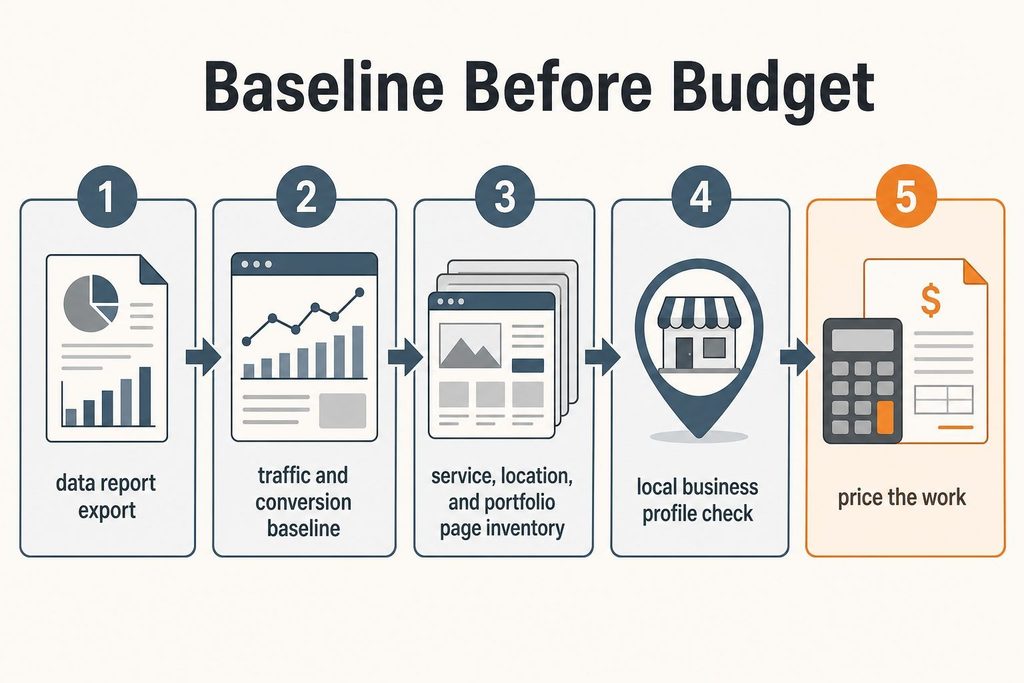
No spend decision here is defensible without a baseline. The order matters, and each step depends on the one before it being finished first.
- Export the Search Console performance report today. It costs nothing, takes minutes, and every decision that follows depends on having it in hand rather than assumed.
- Pull the Analytics baseline alongside it, recording clicks, queries, indexed pages, traffic, bounce rate, and conversion rate. This is what every later comparison gets measured against, so it has to come before anything is spent.
- Inventory the commercial and residential service, location, and portfolio pages, noting which services and areas have no dedicated page at all. This step depends on the baseline above because it tells you which gaps are actually costing traffic, not just which ones look incomplete.
- Check the Google Business Profile for categories, services, hours, and attributes. It is a contained task that can be finished the same day it is started, unlike content production which runs over weeks, which is why it comes after the inventory rather than before it.
- Price the work only once the first four are done. Analysis time, content production, technical remediation, and local profile management each carry a different cost, and a number without that baseline behind it is a guess dressed up as a quote.
Each step is ordered this way because the ones later in the list only make sense once the earlier ones have set the scope. Pricing before the inventory means pricing blind. Checking the profile before pulling the baseline wastes a same-day task on a problem that might not be the priority once the numbers are in.