

How Much Should Your Plumbing Business Reinvest to Guarantee Constant Growth
What happens the month after the marketing invoice gets paid, when the leads show up on the report but the trucks are not busier and nobody in the office can say why? That gap between spend and booked work is where most reinvestment decisions fail, and it rarely shows up until the owner is already three months into a budget nobody stress-tested.
How Should a Plumbing Business Set Its Marketing Budget From Revenue?
The decision is not whether to spend on marketing. It is whether the spend is buying profitable, capacity-matched demand or simply buying activity that looks like growth on a dashboard. Guaranteeing constant growth is not a realistic budget target for a trades business with finite trucks and finite techs. Reinvesting for profitable demand is.
A handful of revenue-based ranges get cited as planning starting points: smaller shops commonly run marketing at 5% to 10% of gross revenue, established companies pushing into new territory run 8% to 12%, and operators fighting in contested markets run 12% to 15%. A related estimate puts a typical monthly marketing spend for a plumbing business at $2,000 to $8,000. None of these numbers are a rule. They are a range to test against the business in front of the owner, not a formula to copy from a slide.
Does the Percentage Match What the Business Can Actually Service?
A percentage of revenue is meaningless without a capacity check. Ten percent of revenue spent on lead generation is a mistake if the business cannot dispatch the jobs those leads create, because unanswered calls and delayed follow-up convert into refunds, one-star reviews, and wasted ad spend simultaneously. The budget has to be sized against how many jobs the current crew can complete profitably in a month, not against a target revenue figure pulled from a growth plan.
What Sequence Actually Tells You If the Percentage Is Affordable?
Before any number gets approved, the business needs its own figures in this order:
- average ticket
- gross profit per job
- cost per job by channel
- rate of repeat jobs
- lifetime customer value
| A budget that looks aggressive on paper | can be conservative once repeat business and lifetime value are counted |
|---|---|
| A budget that looks modest | can be reckless if gross profit per job is thin. |
The percentage is the hypothesis.
This sequence is the test.
Why Can a $45 Cost Per Lead Still Be a Bad Plumbing Marketing Result?
A $45 cost per lead sounds efficient until it is run through the numbers that actually decide profitability, and there is no evidence that $45 is a benchmark any plumbing business should expect to hit. Treat any lead cost as a figure to be tested against booked-job economics, not a target to celebrate on its own.
The test looks like this, worked through in order:
- Record the actual cost per lead for the channel, by campaign, not blended across everything running at once.
- Count how many of those leads convert into a booked, completed job, not just an answered call.
- Divide total spend by booked jobs to get a true cost per job, which is almost always higher than cost per lead.
- Compare that cost per job against gross profit and average ticket for the job type the lead produced.
- Weigh the result against repeat-job likelihood and lifetime customer value, since a first job at breakeven can still be a good buy.
A cheap PPC or Google Ads lead that turns into an untracked call, a missed callback, or a low-value drain-clearing job with no repeat potential can cost more in real terms than a $90 lead that books a repiping job with a five-year customer relationship attached.
Which Jobs Should the Budget Buy First: Emergency or Scheduled Service?
Emergency plumbing marketing and scheduled-service marketing are not the same purchase, and treating them as one line item is where a lot of budgets lose their shape. Emergency demand is won or lost in minutes: a burst pipe search leads to a call, and the business that answers fastest with the clearest local presence gets the job, regardless of who spent more on the ad. That timing pressure changes what emergency spend has to prioritize:
- Speed of visibility matters more than polish, since the searcher is choosing from whoever appears first, not whoever has the best-designed ad.
- Speed of call handling matters more than script quality, since a missed call on an emergency lead is a lost job with no second chance that afternoon.
- Local presence signals, like a Google Business Profile with current hours and reviews, decide who gets the click before the phone ever rings.
Scheduled work, by contrast, can absorb a longer decision window. A water heater replacement or a fixture upgrade gets researched, compared, sometimes delayed a week. That slack means scheduled-service spend should be judged against planned crew capacity, job value, and repeat potential rather than against speed alone. The budget decision that actually matters happens before any channel gets chosen: what mix of emergency and scheduled jobs is the business trying to create, and does the crew have room for both.
How Should Plumbing Marketing Spend Be Divided Across Ads, SEO, and Local Visibility?
Once the job mix is decided, the allocation follows a fixed order rather than a fixed formula:
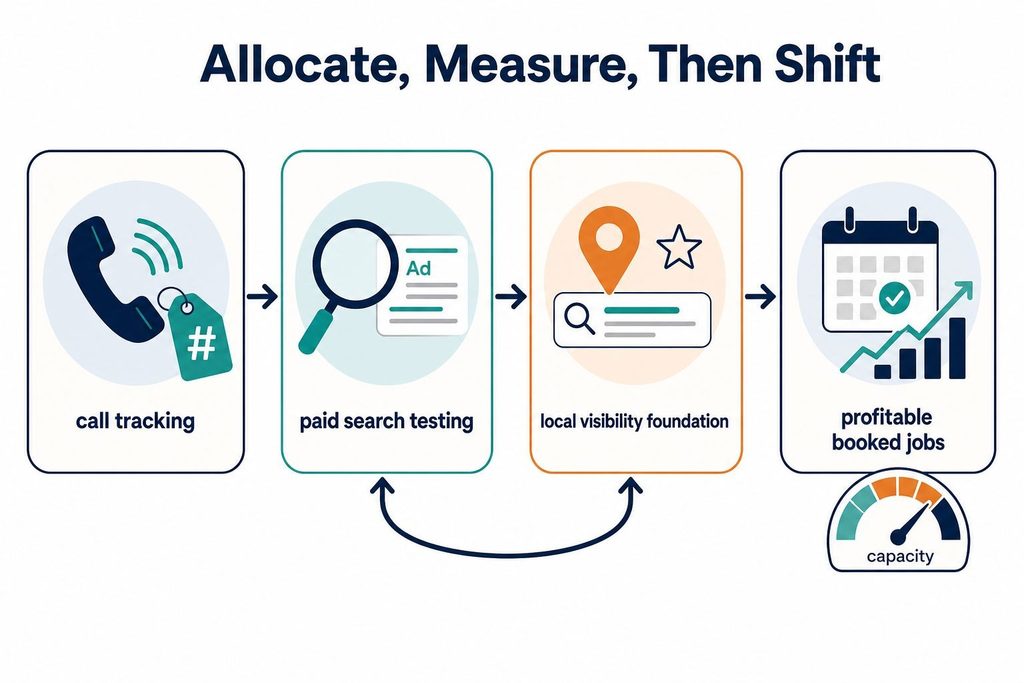
- Fund call tracking first, before any new channel spend, because nothing after this step can be measured without it.
- Put the next dollars into Google Ads or PPC to test immediate demand, since paid search is the fastest way to generate a measurable volume of leads to run through the cost-per-job calculation.
- Maintain Google Business Profile, local SEO, and reputation management as the ongoing base layer, since these compound over time and support both emergency visibility and scheduled-service trust.
- Shift the next increment of budget toward whichever channel is producing profitable booked jobs, not whichever channel produced the cheapest leads.
Whether SEO or ads gets the larger share is not a fixed split. It is governed by how urgently jobs are needed, how much capacity exists to fill, and what cost per job the tracking data actually shows.
What Should Be Changed After the First Measurement Cycle?
Once cost per lead, cost per job, and repeat-job data exist for a full cycle, the budget stops being a hypothesis and becomes a set of decisions. The same dollar amount that looked defensible on a percentage basis can be wrong once booked-job profit is visible, and adjusting it is not a failure of the original plan, it is the plan working.
| Situation Observed | Right Choice |
|---|---|
| Leads cost more than expected but convert into profitable booked jobs | Keep the channel funded and look for ways to lower cost per job further |
| Leads are cheap but rarely become booked, profitable work | Cut or pause the channel and audit dispatch follow-up before spending more |
| Emergency crew capacity is already full most weeks | Redirect new spend toward scheduled-service demand instead of more emergency leads |
| Google Business Profile and local SEO show weak visibility against the job volume needed | Fund reputation management and local SEO before adding more paid spend |
| No reliable lead-to-job data exists yet | Turn on call tracking today before approving any further budget change |