
When SEO Isn’t Fast Enough: Driving Immediate High-Intent Leads with Google Ads
What does it cost a general contractor to wait four to eight months for organic rankings to close a gap in the crew schedule?
Most budget approvers have never priced that wait in real terms: idle estimators, a subcontractor roster held on standby, a slow quarter that shows up in the financials before it shows up in search console. The question is rarely asked because the alternative, paid search, gets judged by a different and looser standard: clicks, impressions, a vague sense of “more traffic.” That standard is not good enough for a decision involving real money and a real crew.
Why Do General Contractors Need Pay Per Click When SEO Is Slow?
Pay per click, run through Google Ads search campaigns, puts a contractor’s business in front of someone typing a high-intent phrase into a search bar:
- right now
- not in six months.
Organic search visibility for a general contracting site is a compounding asset, built through:
- content
- backlinks
- site authority,
and it typically takes months to move a page from the second results screen to the first.
That timeline is fine when the pipeline is healthy. It is not fine when a slow season, a canceled project, or a new service area leaves capacity unsold this quarter. Paid search does not replace organic work; it fills the gap while organic work matures, and the two channels answer different questions on different clocks.
What Makes a Search Query Worth Paying For
A query like “kitchen remodel contractor [city]” or “commercial roofing estimate near me” signals someone close to hiring, not someone browsing ideas. Localized, high-intent phrases like these are what search ads are built to capture, because the searcher has already done the research phase that organic content usually serves. The value of a click depends entirely on how close that searcher is to requesting a quote, not on how many people saw the ad.
Which Services and Areas Should Get the Budget
Not every service line deserves paid traffic, and not every service area is worth bidding into. A campaign only makes sense where the business has open capacity to sell, current pricing to quote confidently, and a service area small enough that leads arrive within a drivable, biddable radius. Spending on a service that is already booked out, or a zip code the crew cannot realistically reach, converts budget into wasted clicks before the campaign has a chance to prove itself.
What Can Google Ads Cost, and Where Can It Go Wrong?
The honest answer starts with separating the line items, because “how much does Google Ads cost” is really four questions: cost per click, daily budget, landing page and tracking setup, and ongoing management.
A 2026 benchmark report for construction marketing puts Google Ads CPC for construction at $5.28 with a 4.12% click-through rate, and a separate industry guide cites an average cost per lead of $165.67 for general contracting. Those numbers are directional baselines from broader category data, not a quote for any specific campaign, service, or market.
- Search ads and organic search answer the same demand on different timelines. Search ads deliver immediate visibility tied to active intent, with cost control set daily through budget and bids, and they fit quote-ready demand well when keywords and areas are capacity-matched; the downside is wasted spend on broad or irrelevant terms.
- Organic search is slow to build and compounds over months, with cost mostly buried in labor and content rather than a bid, and it fits quote-ready demand once ranked, though the payoff is delayed by months of limited visibility.
- Paid social sits apart from both: reach is immediate but purchase intent is weaker, cost control is direct but clicks skew lower-intent, and the channel leans more toward awareness than quote-ready inquiries, with a higher share of unqualified leads as the tradeoff.
The failure points sit at three moments: before the click, when loose or broad keywords pull in searchers with no real project; after the click, when a weak landing page or an unanswered phone line loses someone who was ready to convert; and at the quote stage, when the inquiry that does arrive is unqualified or priced below the margin the business needs.
How Can a Contractor Tell Whether PPC Is Producing Quotes, Not Just Clicks?
Before adjusting budget, spend, or channel, confirm that conversion tracking and call tracking are actually installed and firing correctly. This is the cheapest diagnostic available, it costs nothing beyond an audit, and it is the step most campaigns skip before someone declares the channel “not working.”
Once tracking is confirmed, the campaign should be run through a fixed sequence rather than adjusted by instinct:
- Service and area selection: pick only where there is confirmed capacity to sell and staff the work.
- Keyword grouping: cluster localized, high-intent terms by service, not by broad category.
- Negative keywords: exclude searches that signal browsing, DIY intent, or job-seeking rather than hiring.
- Budget cap: set a daily and monthly ceiling before launch, not after overspend.
- Landing page match: send each ad group to a page built for that specific service and area.
- Tracked actions: confirm every form and phone call attributes back to the campaign.
- Lead record: log qualified leads, quotes issued, and jobs booked, not just form fills.
- Cost review: calculate cost per lead, conversion rate, and ROI against actual booked-job value.
Targeting decides who arrives; the landing page and response process decide whether they convert. A page that does not match the ad’s service and area, or a call that goes to voicemail during business hours, breaks the chain after the money has already been spent on the click. If cost per lead and booked-job economics hold up against margin, the campaign has earned a larger budget. If they do not, the answer is to pause and diagnose the specific failure point rather than pull funding from the channel outright.
What Should Happen in the First 48 Hours?
The order below matters because a budget increase on unmeasured or mistargeted traffic multiplies the same waste it was meant to fix. Each step has to be confirmed before the next one is worth doing.
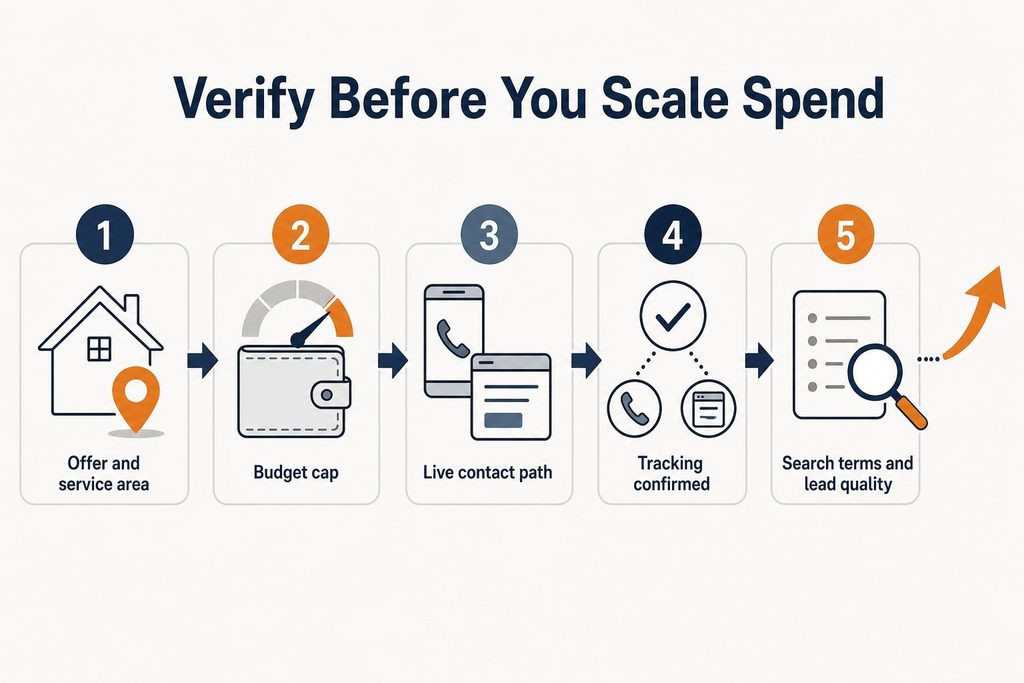
- Confirm the service-area offer being advertised. If the offer itself is unclear or mismatched to current capacity, nothing downstream can be trusted.
- Check the budget cap in the account. A cap set after the fact is not a cap; it is a bill already run up.
- Verify the contact path on the landing page. A phone number or form that does not reach a live response undoes everything spent to get the click there.
- Confirm calls and form submissions are being tracked and attributed. Without this, every later number is a guess dressed up as data.
- Review the search terms report and recent lead quality. This step comes last on purpose, because reviewing performance before the first four are verified only measures noise.
The one thing to do today: calculate the maximum acceptable cost per qualified lead for one service-area campaign, based on that job’s expected value and margin, and use that number as the ceiling for every spend decision that follows.